

How to Get Rid of Bed Bugs in PA & NJ: Step-by-Step
Bed bugs infest 20% of U.S. homes and hotels annually, with Philadelphia ranking as the most bed bug-infested city in America.
Eastern Pennsylvania and New Jersey residents face heightened risk due to their close proximity to infestation hotspots like Philadelphia and New York, and to high apartment density in urban centers where bed bugs spread through shared walls.
However, bed bugs can infest any home, hotel, or commercial business across the region, hitchhiking on shared luggage and second-hand goods.
Bed bugs reproduce rapidly once they establish a shelter—a single female lays 200 to 500 eggs over her lifetime, with eggs hatching in 6 to 10 days.
If untreated, infestations spread from bedrooms to baseboards, electrical outlets, and furniture within weeks, making DIY removal virtually impossible.
Early identification and immediate action are critical because bed bugs hiding behind walls remain undetected while populations explode.
This guide provides step-by-step instructions on how to identify bed bugs, immediate containment steps, choosing the right professional treatment options (heat vs. chemical), and implementing prevention strategies to stop reinfestations.

Step 1: Identify Bed Bugs
Adult bed bugs are roughly 1/4 inch long (apple seed size) with flat, oval, reddish-brown bodies. After feeding, they swell and turn dark red.
While they cannot jump or fly, they can crawl 3–4 feet per minute. Some young bed bugs and larvae can be spotted with the naked eye, but this may require some close concentration.
Bed bugs may be confused with lice, which are smaller on average (only ⅛ inch in size).
Because bed bugs are elusive, the best way to identify an infestation is to look for these key signs:
- Bloodstains on sheets: Resulting from bed bugs feeding or being accidentally crushed when you move in your sleep.
- Musty odor: A distinct smell produced by pheromones when the bugs are threatened or dead.
- Bed bug bites: Physical evidence of these parasites feasting on your blood.
- Bed bug shells: Discarded bed bug casings shed by juveniles, which often indicate a sizable population.
- Live sightings: Frequently spotting live bugs in your home is a clear alert of a large infestation.
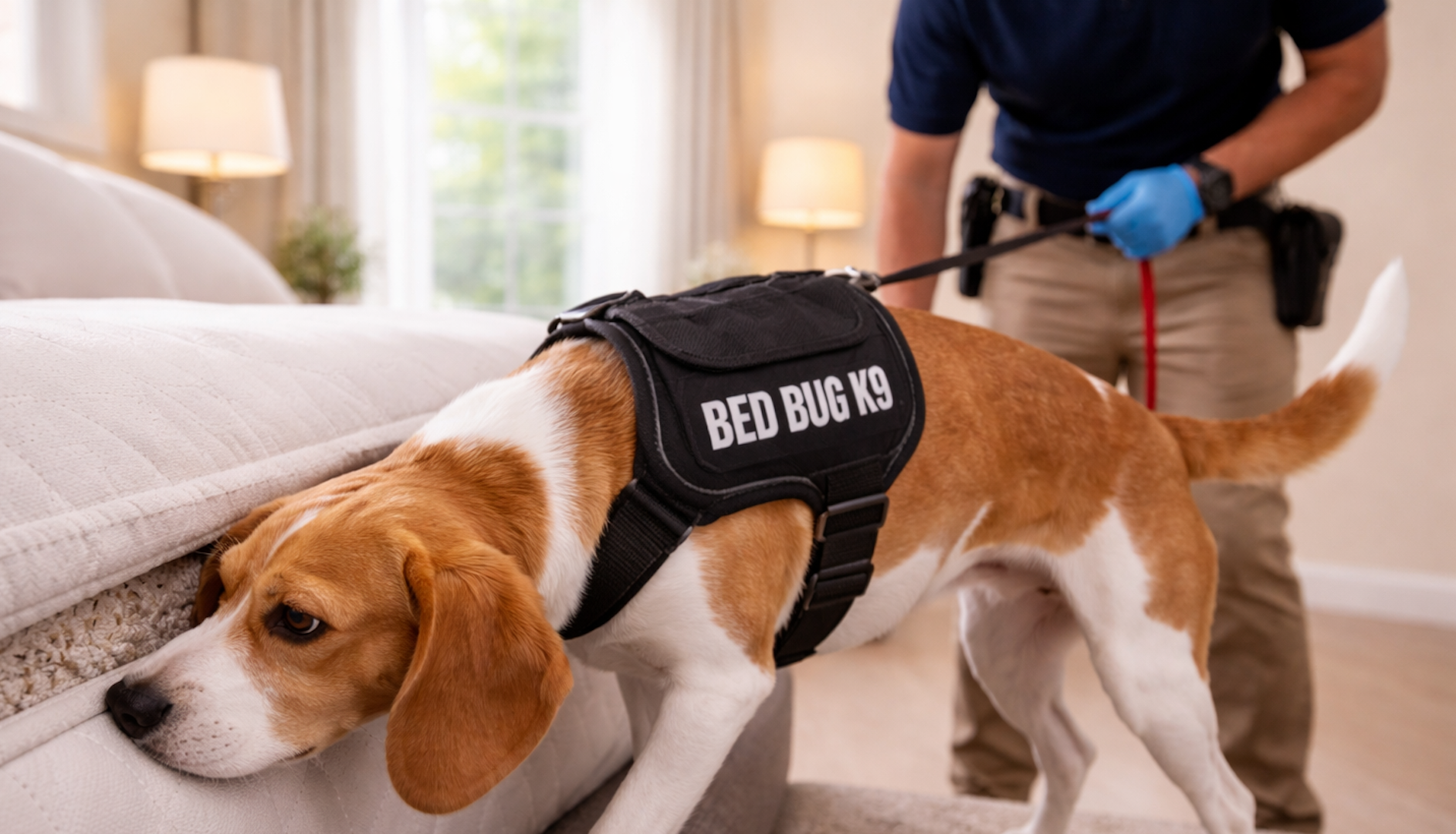
Rutgers University research found that 50% of residents with bed bug infestations remain unaware until the infestation becomes severe. Professional K9 inspections detect 95% of infestations through visual examination of mattress seams, box springs, and furniture—more reliable than waiting for bite reactions.
Step 2: Seal Off the Infestation
Bed bugs travel 100+ feet per night searching for hosts. Containment prevents spread to other rooms and neighboring apartments in multi-unit buildings.
- Close infested room doors: Prevent pets and children from entering. Bed bugs hide in clothing and spread through contact.
- Seal electrical outlets: Install outlet covers. Bed bugs hide behind outlet plates and travel through wall voids to adjacent rooms and apartments.
- Isolate infested items: Place bedding, clothing, and soft items in sealed plastic bags immediately. Do not carry unsealed items through the house–bed bugs transfer during movement.
- Avoid moving furniture: Moving infested furniture to other rooms spreads bed bugs. Leave furniture in place until professional treatment.
- Do not use bug bombs: Total release foggers scatter bed bugs deeper into walls and do not penetrate hiding spots. EPA studies show foggers are ineffective against bed bugs.
- Contact professional pest control immediately: DIY treatments fail because bed bugs hide in inaccessible locations (wall voids, electrical boxes, furniture interiors). Professional treatment is required for elimination.
In apartment buildings and row homes common in eastern PA and southwestern NJ, untreated infestations spread through shared walls within weeks. Notify building management immediately, as coordinated treatment of adjacent units prevents reinfestation.
Step 3: Prepare Your Home for Treatment
Preparation ensures your exterminator can do their job fully without interruption. Requirements vary by treatment method.
Chemical treatments require extensive prep, while heat treatments require minimal prep.
Chemical Treatment Preparation
- Wash all bedding, clothing, curtains, and fabric items: Use hot water (minimum 120°F) and dry on high heat for 30+ minutes. Bag washed items in sealed plastic to prevent reinfestation.
- Empty closets and dressers completely: All items must be removed for chemical application to surfaces.
- Remove clutter: Eliminate hiding spots, including stacks of magazines, boxes, and items under beds.
- Pull furniture away from walls: Create 2-foot clearance for baseboard treatment access.
- Vacuum thoroughly: Remove bed bugs from carpets, mattress seams, and furniture crevices. Immediately seal the plastic bag and discard it outdoors.
- Seal cracks and crevices with caulk: Prevent bed bugs from retreating into wall voids during treatment.
Heat Treatment Preparation
- Remove heat-sensitive items: Medications, aerosol cans, lighters, candles, vinyl records, cassette tapes, photo albums, wax items, oil paintings, and chocolates.
- Unplug electronics: Temperatures reach 135°F to 160°F—electronics must be unplugged, but do not require removal (except plasma TVs).
- Open closets and drawers: Allow heat circulation to all hiding spots.
- Remove pets and plants: Heat levels are lethal to animals and vegetation.
- Minimal fabric handling: Unlike chemical prep, bedding and clothing remain in place and are treated with heat.
Step 4: Eliminate Bed Bugs with Professional Treatment Methods
Professionals generally use two primary methods to eliminate infestations, often combining them for an Integrated Pest Management (IPM) approach:
Heat Treatment (Thermal Remediation)
Industrial heaters raise room temperatures to 135°F–160°F for several hours to kill all life stages, including eggs.
- Pros: Achieves 99% elimination in a single day; non-toxic; reaches inaccessible areas like wall voids.
- Cons: Higher upfront cost ($1,500–$3,000); no residual protection against reintroduction.
Chemical Treatment
Technicians apply a combination of contact killers, residual insecticides, and growth regulators over 2–4 visits.
- Pros: More affordable ($300–$800 per visit); provides lasting chemical barriers to kill bugs over time.
- Cons: Requires multiple treatments over 4–8 weeks; does not kill eggs; significant preparation needed; risk of insecticide resistance.
Pro-Tip: Many experts recommend heat treatment for an immediate knockdown followed by a chemical perimeter for long-term prevention. Your exterminator will recommend a plan based on your property and the level of infestation.
Step 5: Post-Treatment Inspection and Monitoring
Professional treatments include follow-up inspections to verify elimination. Heat treatments typically include one follow-up inspection at 7 to 14 days. Chemical treatments require inspections before each retreatment (every 10-14 days).
K9 bed bug detection dogs identify infestations with 95%+ accuracy, detecting live bugs and viable eggs through scent. K9 inspections confirm elimination and detect reintroductions before populations expand.
Your exterminator will check for the following reinfestation signs:
- Inspect mattress seams weekly for fecal spots or live bugs
- Check bed bug interceptors placed under bed legs — shallow dishes trap bed bugs climbing to/from beds
- Monitor for new bite marks appearing in lines or clusters
- Watch for bloodstains or fecal spots on new bedding
- Set passive monitors (sticky traps) along baseboards and furniture
Contact a pest control professional immediately if any signs reappear. Early retreatment prevents small reintroductions from becoming full infestations.
Step 6: Practice Proper Prevention
Bed bugs enter homes through travel, secondhand furniture, and visitors. Prevention focuses on eliminating entry pathways:
- Inspect hotel rooms before unpacking: Check mattress seams, headboards, furniture for fecal spots
- Elevate luggage on bathroom counters or metal racks—never on beds or floors
- Immediately launder all clothing after travel: Hot water wash, high heat dry 30+ minutes
- Inspect secondhand furniture thoroughly before bringing inside; avoid upholstered items from unknown sources
- Seal cracks in walls and baseboards—bed bugs hide in 1/16″ gaps
- Use mattress and box spring encasements to prevent bed bug entry
- Reduce clutter to eliminate hiding spots
- In apartments, use caution in shared laundry facilities where bed bugs transfer between residents’ items
These tips will reduce the chances of a bed bug encounter. However, for commercial properties, including hotels and motels where bed bugs are more common, it’s essential to invest in a bed bug protection plan that offers frequent inspections and rapid response times.
How Bed Bugs Enter PA & NJ Homes
Bed bugs enter homes exclusively through transport on items and people, such as:
- Travel: Luggage, clothing, and personal items from hotels, Airbnbs, and vacation rentals. Proximity between Philadelphia and NYC increases exposure for PA and NJ residents.
- Secondhand furniture: Used mattresses, couches, dressers, and chairs from thrift stores, yard sales, or curbside pickups.
- Visitors: Guests who unknowingly carry bed bugs on clothing, bags, or personal items introduce infestations.
- Shared laundry facilities: Apartment buildings and laundromats, where bed bugs transfer between residents’ items.
- Adjacent apartments: Multi-unit buildings (common in Camden, Trenton, Philadelphia suburbs) allow bed bugs to travel through shared walls, pipes, and electrical conduits.
- Workplaces and schools: Bed bugs hide in backpacks, coats, and bags, and can transfer between locations.
Contrary to what you might think, bed bugs can make their way into even the cleanest homes.
Peak travel seasons (summer vacation, winter holidays) correlate with increased bed bug activity as travelers unknowingly transport bed bugs home.
Follow these tips to stay protected and to know when to contact an exterminator to stop infestations before they spread.
FAQs
What kills bed bugs instantly?
Heat above 122°F kills bed bugs instantly. Steam at 130°F+ kills on contact. Temperatures between 118°F and 122°F kill bed bugs within 90 minutes. Professional heat treatments maintain 135°F to 160°F for hours, ensuring lethal temperatures penetrate all hiding spots including mattresses, furniture, and wall voids. High-heat dryers (minimum 120°F for 30+ minutes) kill bed bugs in clothing and bedding.
Do bed bugs go away naturally?
No. Bed bugs do not leave voluntarily when hosts are present. Bed bugs survive 12+ months without feeding in favorable conditions. Populations continue reproducing (200-500 eggs per female lifetime) until professional elimination occurs. Ignoring infestations allows populations to expand from bedrooms into walls, furniture, and adjacent rooms or apartments.
Can I get rid of bed bugs myself?
DIY elimination fails in 80%+ of cases because bed bugs hide in inaccessible locations (wall voids, electrical outlets, furniture interiors) that DIY methods cannot reach. Over-the-counter pesticides are ineffective due to widespread insecticide resistance. Professional treatment using heat or professional-grade chemicals with proper application techniques is required for reliable elimination. DIY methods like laundering and steaming supplement professional treatment but cannot replace it.
How long does bed bug treatment take?
Heat treatment eliminates infestations in one 6 to 8 hour session with immediate results. Chemical treatment requires 2 to 4 appointments over 4 to 8 weeks — initial treatment plus follow-ups every 10 to 14 days to kill newly hatched nymphs. Treatment duration depends on infestation severity, home size, and clutter level affecting hiding spots.
How much does professional bed bug treatment cost?
Heat treatment costs $1,200 to $3,000+ for whole-home treatment, depending on size. Chemical treatment costs $650 per application, with 2 to 4 treatments required. Severe infestations, large homes, and high clutter increase costs. Heat treatment has a higher upfront cost but eliminates infestations faster. Chemical treatment spreads costs over weeks but requires multiple treatments and extensive preparation time.
Are bed bugs dangerous or do they spread disease?
According to CDC research, bed bugs do not transmit diseases. Health impacts include itchy bite reactions, secondary skin infections from scratching, allergic reactions (rare), anxiety, insomnia, and psychological distress from infestation stress. Some people show no bite reactions, while others develop severe welts requiring medical attention.
Can bed bugs live in walls?
Yes. Bed bugs hide in wall voids, behind baseboards, inside electrical outlets, and within wall-mounted picture frames. They travel through walls between apartments in multi-unit buildings. Wall infestations make DIY treatment impossible and require professional heat treatment (penetrates walls) or chemical injection into voids. This wall-traveling behavior explains the rapid spread of infestation in apartment buildings common throughout eastern PA and southwestern NJ.
How do I know if bed bug treatment worked?
Signs of successful treatment: no new bite marks after 2+ weeks, no live bed bugs during inspections, no fecal spots on bedding or furniture, no bed bugs captured in interceptors or monitors. Professional follow-up inspections (visual or K9) confirm elimination. Most reputable companies provide warranties ranging from 30 days (chemical) to 1 year (heat treatment) and will retreat if bed bugs return within the warranty period.


How to Meet Restaurant Pest Control Standards in PA & NJ
Restaurants face higher pest risks than other businesses because of constant access to food, organic waste, moisture, and high-traffic entry points.
Beyond the physical damage to equipment and wiring, pests like mice, cockroaches, and flies carry salmonella and E. coli, leading to immediate health inspection failures, fines, or closures.
In Pennsylvania and New Jersey, restaurants must adhere to FDA Food Code standards and state Department of Agriculture regulations. Because commercial pest control accounts for 20% of a health inspection score, even a single sighting can lower your grade, trigger a violation, and damage your reputation.
A 2022 survey found that 66% of food service establishments experienced rodent infestations.
This guide covers Pennsylvania and New Jersey’s specific pest regulations, common pests they encounter, and seven essential practices to keep your facility compliant and protected.
PA & NJ Regulations for Restaurant Pest Control
Both Pennsylvania and New Jersey restaurants operate under the FDA Food Code, which requires establishments to maintain a pest-free environment through routine inspections, approved control methods, and professional service documentation.
Under Pennsylvania Code Title 7 and New Jersey Administrative Code N.J.A.C. 8:24, businesses must also utilize tamper-resistant rodent bait stations and certified pesticide applicators for restricted-use products.
Failure to comply with these regulations leads to:
- Official inspection failures and reinspection fees.
- Negative health grades that impact public reputation.
- Temporary closures or full license suspension for severe violations.
Health department inspections occur every 10 to 12 months for compliant establishments. Pennsylvania’s seven counties (Allegheny, Bucks, Chester, Delaware, Erie, Montgomery, Philadelphia) plus ~100 municipalities conduct independent inspections.
New Jersey county and municipal health departments perform annual surprise inspections.
Finally, both states require HACCP (Hazard Analysis and Critical Control Points) plans for high-risk operations. Restaurants must document pest control services, including dates, findings, treatments, and corrective actions.
Records must be available for inspection and maintained for a minimum of 12 months in Pennsylvania and 3 years in New Jersey.
How Pest Control Complies with ServSafe
ServSafe is a food and beverage safety training program that helps restaurants prevent food-borne illnesses and maintain the highest level of food safety.
Routine pest control can help your restaurant comply with ServSafe standards by ensuring no pests infest your kitchen or dining area and compromise the safety and integrity of your establishment.
Following ServSafe protocols is essential for passing health inspections and getting a positive report.
Common Restaurant Pests in Pennsylvania
Pennsylvania and New Jersey restaurants face five primary pest groups that threaten food safety and regulatory compliance:
Rodents (Mice and Rats)
Rodents can squeeze through gaps as small as 1/4 inch, often entering through loading docks or damaged weather stripping. Once inside, they contaminate food and surfaces with droppings carrying salmonella and hantavirus.
They also pose significant fire hazards to your building, as they are liable to chew on insulation and wiring because they have a constant need to chew to prevent their teeth from growing.
German Cockroaches
The leading pest problem for U.S. restaurants, German cockroaches thrive in warm, moist areas like sinks and dishwashers. They spread E. coli and Salmonella, and spotting one during the day often indicates a severe, overcrowded infestation.
Cockroaches also reproduce extremely rapidly. A single female produces 4 to 8 egg cases during her lifetime, each containing 30 to 40 eggs. Populations explode within weeks if left unchecked, especially in areas like restaurants with steady food supplies.
Flies (Fruit Flies, House Flies, Drain Flies)
Flies breed rapidly in organic waste, clogged drains, and damp mop buckets. They transmit over 100 different pathogens by moving between exterior garbage and interior food prep surfaces, regurgitating digestive enzymes that spread bacteria onto everything they touch.
Ants
Pavement ants and odorous house ants enter restaurants through foundation cracks and gaps around doors, searching for sugar and protein. They establish chemical trails from nests to food sources, bringing thousands of workers once trails are established.
Ants contaminate food through direct contact and by transporting bacteria from their outdoor nests onto their bodies.
Stored Product Pests (Beetles, Moths, Weevils)
Stored product pests infest grains, flour, cereals, nuts, dried fruit, and spices. Indian meal moths, cigarette beetles, and grain weevils enter facilities in infested products, then spread throughout dry storage areas.
Larvae feed inside food packages, contaminating entire lots. Infestations require discarding all affected products and deep-cleaning storage areas—costs that can reach thousands of dollars for large infestations.
7 Best Practices to Follow Restaurant Pest Control Regulations
Following pest control regulations is easier when working with a professional pest control company. The following are seven best practices for maintaining FDA Food Code and state regulatory compliance for dealing with pests inside restaurants.
1. Schedule Monthly Professional Inspections
Restaurants require at least monthly professional inspections, though high-risk sites may need weekly visits to catch infestations early.
Technicians identify conducive conditions, monitor traps, and provide the documentation necessary for health department compliance.
Utilizing the EPA’s own Integrated Pest Management (IPM) focuses on long-term prevention and exclusion to reduce the need for heavy pesticide use.
2. Implement Proper Food Storage Protocols
Store all food in sealed, commercial-grade containers elevated 6 inches off the floor to prevent pest access and allow for easy cleaning.
Following a First-In-First-Out (FIFO) rotation ensures products don’t sit long enough to attract pests, while discarding original cardboard boxes immediately removes common “hitchhiker” hiding spots.
3. Maintain Rigorous Cleaning Standards
Daily “clean-as-you-go” protocols and nightly degreasing of floors prevent the accumulation of grease and debris that feed pests. It is critical to move equipment weekly for deep cleaning and to treat floor drains with enzymatic cleaners to eliminate organic buildup where drain flies breed.
4. Follow Strict Waste Management Procedures
Garbage is a primary attractant for pests; all bins must have tight lids and be emptied frequently throughout the day.
Exterior dumpsters should be kept at least 25 feet from the building on concrete pads, and all recyclables must be rinsed to remove odors that draw in rodents and insects.
5. Train Staff on Pest Prevention Protocols
Consistent prevention relies on staff trained to identify pests, properly manage food storage, and report sightings immediately. Quarterly refresher training ensures that every employee understands their role in maintaining ServSafe standards and facility hygiene.
6. Seal Entry Points and Eliminate Harborage
Exclusion is the most effective defense against pests.
Seal all foundation cracks and utility gaps with commercial sealant or copper mesh. Ensure exterior doors have functional sweeps with no more than a 1/4-inch gap, and keep landscaping trimmed at least 18 inches from the building to remove natural hiding spots.
7. Deploy Monitoring and Control Systems
Strategic use of numbered glue boards, pheromone traps, and UV light traps allows for the early detection of developing pest populations. Per state regulations, all rodent bait must be housed in covered, tamper-resistant stations and checked weekly to monitor and document activity levels.
Preparing for PA & NJ Health Inspections
Health inspections occur annually for compliant establishments, and more frequently for those with violations. Inspections can be announced or unannounced in both states. Preparation ensures readiness regardless of timing:
- Maintain pest control service records: Document all inspections, treatments, and corrective actions. PA requires 12-month retention; NJ requires 3-year retention. Inspectors review documentation to verify active pest management programs.
- Ensure monitoring devices are in place: Glue boards, bait stations, and traps should be properly positioned, numbered, and maintained. Missing or poorly maintained devices indicate inadequate pest control.
- Fix pest conducive conditions: Seal gaps, repair screens, eliminate standing water, and remove clutter before inspections. Conducive conditions violate health codes even without active infestations.
- Remove pest evidence: Clean up droppings, dead insects, and pest damage immediately. Evidence of pests, even if pests are no longer present, triggers violations.
- Verify proper chemical storage: Pesticides must be stored in locked cabinets away from food, labeled properly, and limited to products approved for food facility use.
- Train staff on inspection protocols: Employees should know not to disturb inspection processes and should answer inspector questions accurately without speculation.
Inspection failures require reinspections costing $200 to $400 and delay reopening. Severe violations result in immediate closure until corrected. Grade reductions damage reputation and reduce customer traffic.
Proactive pest management prevents violations and maintains grades. At The Pest Rangers, we follow standards set by the Food Safety Modernization Act and use different quality control standards in food processing designed to thwart pests and keep your restaurant safe. Contact us today for more information and a quote!
FAQs
How often should restaurants have pest control inspections?
Monthly inspections minimum. High-risk restaurants with previous infestations require weekly or bi-weekly inspections. Monthly frequency detects early infestation signs before populations reach damaging levels and demonstrates active pest management programs during health inspections.
Are pesticides safe to use in restaurants?
Only when applied by state-certified pesticide applicators following label instructions and FDA/USDA regulations. Pesticides must be approved for food facility use, applied to prevent food contamination, and stored in locked cabinets. Professional pest control ensures legal compliance and safe application. DIY pesticide use by untrained staff often violates regulations.
What happens if a restaurant fails a health inspection for pests?
Inspection failures require immediate corrective action and reinspection. Minor violations allow continued operation with reinspection scheduled within days or weeks.
Severe violations (live pest infestations, extensive contamination) result in immediate closure until corrected. Reinspection fees cost $200 to $400. Repeated failures can result in license suspension or revocation.
Do restaurants need documentation of pest control services?
Yes. Health inspectors review pest control service records during inspections. Documentation must include service dates, areas inspected, findings, treatments applied, and recommendations.
Pennsylvania requires 12-month record retention; New Jersey requires 3-year retention. Lack of documentation indicates the absence of active pest management programs and results in violations even without visible pest activity.
Can restaurants treat pest problems themselves?
Limited DIY pest control is allowed using over-the-counter products like glue boards and non-toxic monitors. Restricted-use pesticides require application by state-certified applicators.
Most restaurants lack the expertise to identify pest species, locate nests, apply treatments safely, and maintain documentation required by regulations. Professional services ensure compliance and provide superior control.
What are the most common pest violations in PA & NJ restaurants?
Live rodents or insects present during inspection, pest droppings in food storage or prep areas, chewed or damaged food packaging, inadequate pest monitoring devices, failure to correct conducive conditions (unsealed gaps, standing water, clutter), and lack of pest control service documentation.
Even a single pest sighting can trigger violations and grade reductions.
How to Prepare for the Bed Bug Surge in the Northeast
As the summer travel season approaches, bed bug infestations are surging across the Sun Belt, but the threat is moving north faster than the warm weather.
While Georgia, Florida, and Tennessee are seeing record service requests, New York-based travel expert Lee Abbamonte warns that businesses and travelers in Pennsylvania and New Jersey must be on high alert as the cold departs.
The risk of transmission is significantly higher in 2026 as travel volumes reach new heights. Recent findings from AAA show that 39% of Americans plan to take more vacations this year than in 2025, with 44% of travelers in the Northeast planning multiple trips of three days or more.
Philadelphia recently ranked as the #1 most bedbug-ridden city in the U.S. in the 2025 Terminix report, with many travelers from New Jersey and Pennsylvania using the city as a central transportation hub across the country.
At The Pest Rangers, our technicians are already identifying cases far beyond city limits, sprouting in Burlington, Camden, Montgomery, and Bucks Counties as travelers return from southern trips or local commutes into the city.
Why Bed Bug Cases Are Surging Across the Country
The recent explosion in bed bug activity is driven by a “perfect storm” of biological and social factors. According to the U.S. Environmental Protection Agency (EPA), the resurgence is primarily fueled by increased global travel, a lack of public awareness regarding prevention, and—most critically—a significant increase in pesticide resistance.
Modern bed bugs have evolved thicker exoskeletons and metabolic adaptations that enable them to survive once-standard chemical treatments, making infestations harder to eradicate and allowing them to persist longer in commercial properties.
As travel volumes surge, these “expert hitchhikers” are moving across the country at record speeds by latching onto luggage, clothing, and electronics.
Major travel hubs like Philadelphia have created permanent “reservoirs” for these pests, where they are easily transported into surrounding communities via daily commutes and vacation travel.
The EPA notes that the pest control industry has shifted toward targeted baiting for ants and cockroaches, which offers no “collateral” protection against bed bugs. Without the preventative barriers provided by older broad-spectrum treatments, a single introduced bed bug is much more likely to establish a full-blown colony.
Combined with warming global temperatures that extend their active season, experts suggest that these pests have moved from a seasonal nuisance to a year-round threat for commercial property owners.
How Bed Bugs Spread Through Commercial Properties
Bed bugs are “hitchhiker pests” that rely almost entirely on human mobility to colonize new environments.
According to the U.S. Environmental Protection Agency (EPA), these pests do not fly or jump; instead, they move between commercial properties by latching onto luggage, overnight bags, clothing, and even second-hand furniture.
Once introduced into a building, they can easily migrate between rooms through wall voids, electrical plate covers, and plumbing chases, allowing a single introduction to quickly become a facility-wide issue.
In high-traffic environments like hotels, retail shops, and apartment complexes, the risk of transmission is significantly higher due to constant “vector” movement. The University of Kentucky notes that this is a persistent challenge for hotels and apartments, where the constant turnover of occupants allows bed bugs to be inadvertently carried in on shoes, wheelchairs, and backpacks.
Because bed bugs can survive for months without a blood meal, they can hide in upholstered seating in office lobbies, movie theaters, or retail changing rooms, waiting for a new host to carry them to a different location.
What Commercial Property Owners Need to Do Right Now to Prepare for Bed Bug Outbreaks
Waiting for a confirmed sighting is the most expensive mistake a business can make. A proactive monitoring program is a fraction of the cost of emergency remediation and the inevitable reputational fallout.
Immediate steps we recommend for all commercial operators outside of metropolitan areas, including smaller areas like Scranton, Wilkes-Barre, and Allentown, include:
- Pre-Season Inspections: Schedule a professional sweep now, before guest volume peaks. Specialized K9 bed bug detection dogs can detect bed bugs with 99% accuracy.
- Staff Vigilance Training: Housekeeping and maintenance staff are your first line of defense. Train them to spot “pepper spot” excrement, shed skins, and rust-colored stains.
- Low-Cost Shields: Install mattress encasements and interceptor traps in all high-risk sleeping or seating areas.
- No-Fault Reporting: Establish a protocol where staff can flag suspicious rooms immediately without fear of repercussion, ensuring early detection.
- Contractor Protocols: Bed bugs can enter via delivery personnel and third-party equipment. Review your vendor entry policies.
- Documented IPM: Work with a licensed professional to create an Integrated Pest Management (IPM) plan. This is a critical legal and insurance asset if a claim ever arises.
Never attempt to eradicate a bed bug infestation on your own. Modern bed bugs are highly adapted to over-the-counter chemical sprays, often developing resistance that makes retail treatments ineffective.
Furthermore, these pests are masters of concealment, nesting deep behind baseboards, inside electrical outlet covers, and within furniture joints–areas that are virtually impossible to reach without professional-grade equipment.
If you suspect or spot a bed bug, don’t wait for the problem to multiply. Schedule a professional heat treatment immediately with The Pest Rangers. Unlike traditional methods, heat treatment penetrates the entire environment, eliminating bed bugs at every life stage—from eggs to adults—in a single service.
The Reputational Stakes Are High
In today’s digital landscape, a single bed bug complaint on Google, TripAdvisor, or Yelp can trigger a devastating cascade of cancellations, negative reviews, and potential legal exposure. For hospitality businesses and commercial property managers, the reputational damage from a publicized infestation can take years to repair.
The cost of a proactive prevention and monitoring program is a small fraction of the cost of crisis management. With Philadelphia currently ranked as the nation’s most bed bug-ridden city and travel-related infestations trending upward, the window to secure your property is closing. Don’t wait for a complaint to act; get ahead of the surge today.
FAQs
Are bed bug infestations really increasing in the Northeast?
Yes. While surges were initially noted in the South, the threat is moving north rapidly. Philadelphia was recently ranked as the #1 most bedbug-ridden city in the U.S. in the 2025 Terminix report. Additionally, travel-related infestations are trending upward as travel volumes reach new heights in 2026.
What types of commercial properties are most at risk?
High-traffic environments are at the highest risk due to constant “vector” movement. These include:
- Hotels and hospitality businesses.
- Apartment complexes.
- Retail shops and changing rooms.
- Office lobbies.
- Movie theaters.
How do bed bugs get into commercial buildings?
Bed bugs primarily enter commercial buildings as “hitchhiker” pests by latching onto human belongings such as luggage, backpacks, and clothing. They are also commonly introduced through the transport of electronics, second-hand furniture, or office equipment. In some cases, they can be brought in by delivery personnel or via third-party equipment moved between different facilities.
What are the early signs of a bed bug problem?
Your staff should be trained to look for several key indicators, including:
- “Pepper spot” excrement.
- Shed skins.
- Rust-colored stains on linens or furniture.
- Sightings in hidden areas like baseboards, electrical outlet covers, and furniture joints.
Contact a local pest control professional at the first sign of bed bugs.
Who is responsible for bed bug treatment in a commercial property?
The document emphasizes that property owners and managers should work with licensed professionals to create an Integrated Pest Management (IPM) plan. It explicitly warns against attempting to eradicate infestations independently, as modern bed bugs have developed significant pesticide resistance to over-the-counter treatments.
How fast should a bed bug issue be addressed?
Immediately. Waiting for a confirmed sighting or a guest complaint is considered an expensive mistake. Because bed bugs can survive for months without a blood meal and multiply quickly, the document recommends proactive monitoring and immediate professional heat treatment the moment a pest is suspected or spotted to avoid facility-wide issues and reputational damage.
How Much Does Termite Treatment Cost in PA and NJ?
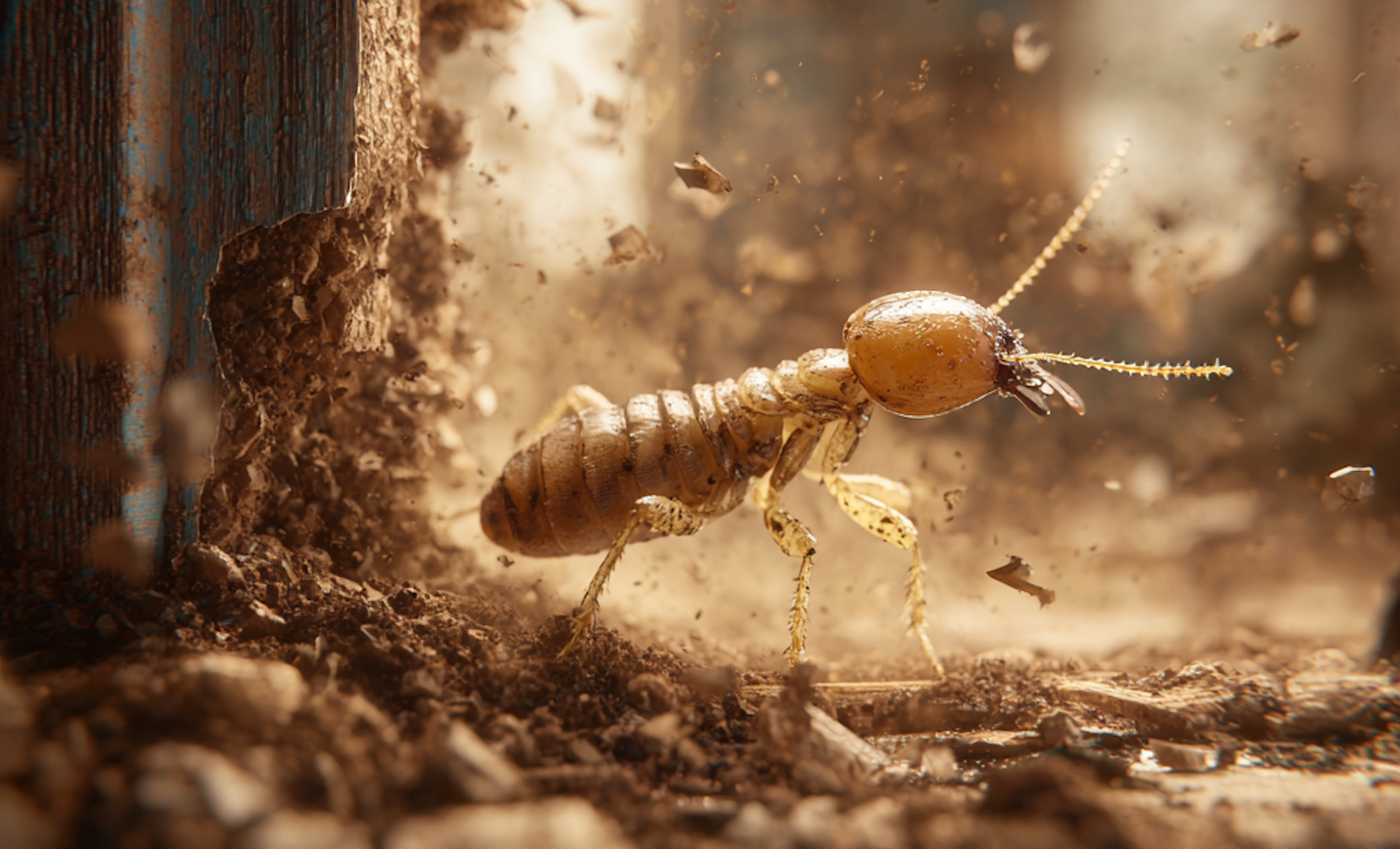
Termite treatment in Pennsylvania and New Jersey costs anywhere from $800 to $5,000 or more for residential properties.
Both states are located in “Termite Infestation Probability Zone 2,” meaning they face moderate to heavy termite activity, primarily from the Eastern subterranean termite.
These termites are highly resilient; to survive the freezing winters of the Northeast, they retreat deep into the soil below the frost line, which in Pennsylvania can reach depths of 42 to 54 inches depending on the severity of the season and soil conditions.
According to the National Pest Management Association, termites cause more than $6.8 billion in property damage across the U.S. every year, and homeowners’ insurance doesn’t cover that damage.
The cost of treating termites depends on the severity of the infestation, the type of termite involved, and the treatment method, all of which push the final number up or down.
Here is a complete breakdown of what termite treatment costs in PA and NJ, what drives those costs, and what to expect when you call for a quote.
| Infestation Level | Pennsylvania Cost | New Jersey Cost | Best Treatment Match |
|---|---|---|---|
| Small / Localized | $800 – $1,500 | $900 – $1,800 | Spot Treatment / Injection |
| Moderate / Active | $1,500 – $3,000 | $1,800 – $3,500 | Liquid Barrier or Baiting |
| Severe / Structural | $3,000 – $5,000+ | $5,000+ | Fumigation or Multi-Step |
| Commercial | $2,500+ | $2,500+ | Custom Monitoring Plan |
Note: Costs reflect residential properties. Commercial pricing varies based on square footage and monitoring requirements.
Note: Costs reflect residential properties. Commercial pricing starts higher due to square footage, liability, and monitoring requirements.
Average Termite Treatment Cost in Pennsylvania
Most Pennsylvania homeowners pay between $800 and $3,000 for termite treatment. Severe infestations involving structural damage can push costs above $5,000.
Subterranean termites are the dominant species in Pennsylvania. Because they build colonies underground, treatment requires soil-applied liquid barriers or bait stations—both of which involve drilling and trenching along the foundation.
Average Termite Treatment Cost in New Jersey
New Jersey homeowners typically pay $900 to $3,500 for standard residential treatment–slightly more than the Pennsylvania averages. Denser housing, higher labor costs, and tighter lot lines all contribute to higher average prices.
Subterranean termites are the primary species throughout the state. Southern NJ counties also see pressure from Formosan termites—a more aggressive species that builds larger colonies and spreads faster. Formosan infestations drive costs higher because they require more intensive treatment and longer monitoring periods.
Multi-unit dwellings and attached homes present additional complexity. Treating one unit in a row home or condo may require coordination with neighbors and building management, which adds time and cost.
What Termite Treatment Typically Includes
- Initial inspection (sometimes included, sometimes separate)
- Liquid soil barrier application or bait station installation
- Trenching and drilling around the foundation
- Annual monitoring plan (often quoted separately)
- Written warranty — usually 1 year, renewable
The further a property is from major metro areas, the more competitive the pricing tends to be. However, rural homes with crawl spaces or older pier-and-beam foundations often require more labor, which can offset those savings.
Termite Treatment Methods and What They Cost
The treatment method is one of the biggest cost drivers in both states. Your pest control technician will recommend the right approach based on the termite species, soil conditions, foundation type, and infestation severity.
| Treatment Type | Upfront Cost | Ongoing Cost | Best For |
|---|---|---|---|
| Liquid Soil Barrier | $1,200 – $3,000 | Low / none | Active subterranean infestations |
| Bait Station System | $800 – $2,500 | $150 – $400/yr | Prevention & monitoring |
| Wood Treatment / Injection | $500 – $1,500 | None | Localized dry-wood issues |
| Fumigation (tent) | $2,000 – $8,000 | None | Severe or whole-structure cases |
Liquid Barrier vs. Bait Stations: Which Costs More?
Liquid soil treatments have a higher upfront cost but typically require less ongoing service. Bait systems cost less to install but include annual renewal fees that add up over time.
For active infestations, most technicians recommend liquid barriers for immediate control, followed by bait stations for long-term monitoring. Some protection plans bundle both into a single annual contract.
What Factors Affect Termite Treatment Cost?
Infestation Severity
Severity is the single biggest cost variable. A localized infestation caught early may require treatment in one or two zones. An advanced infestation can require multiple treatment zones, wall void injections, and replacement of damaged structural wood, all of which add high cost.
This is why calling a professional at the first sign of termites matters. Every month of delay allows the colony to expand and damage the compound.
Property Size and Foundation Type
Larger homes require more product, more labor, and more time. Homes with complex foundations, including crawl spaces, multiple slabs, or pier-and-beam construction, take longer to treat than standard full-basement homes.
Slab-on-grade foundations require drilling through the concrete to reach the soil beneath, which adds both time and material cost.
Inspection and Monitoring Fees
Not all termite treatment quotes cover initial inspections or the necessary long-term monitoring. It is essential to confirm these costs upfront to avoid surprises. Generally, homeowners in PA and NJ can expect the following:
- Standalone termite inspection: $75 to $150 (sometimes free with treatment)
- Annual monitoring plan: $150 to $400 per year
Follow-up monitoring is especially important for subterranean termites. Colonies can re-establish if even a small portion survives treatment. An annual check catches that before it becomes a reinfestation.
Warranties and Protection Plans
Most professional treatment plans include a warranty. Premium plans include damage repair guarantees, which cover the cost of repairs if termites return and cause new damage during the warranty period.
- Standard 1-year renewable warranty: included in most plans
- Multi-year protection plan: $200 to $500 per year
- Damage repair guarantee: included in premium plans
In high-pressure zones across PA and NJ, an ongoing protection plan is worth the investment. The annual cost is a fraction of what a single reinfestation can cost in repairs.
Cost of Repairing Termite Damage in PA and NJ
Treatment eliminates the termites, but it does not fix what they already destroyed. Structural repairs are quoted separately and vary significantly by the extent of damage.
| Damage Type | Estimated Repair Cost |
|---|---|
| Minor trim / cosmetic wood | $500 – $1,500 |
| Floor joist replacement | $2,000 – $6,000 |
| Structural beam repair | $5,000+ |
| Major structural reconstruction | $10,000 – $30,000+ |
Crucial Note: Always complete termite treatment and confirm the colony is eliminated before beginning these repairs to prevent re-infestation of new wood.
Always treat before repairing. Fixing damaged wood while an active colony is present wastes money—termites will return to the new wood. Confirm the infestation is eliminated and the warranty is in place before any contractor starts repair work.
Residential vs. Commercial Termite Treatment Costs
Commercial properties cost more to treat for several reasons: greater square footage, multiple foundation access points, increased liability exposure, and stricter monitoring documentation requirements.
While residential treatment in PA and NJ typically runs $800 to $3,500, commercial quotes start around $2,500 and climb from there based on building size and infestation scope. Multi-building facilities, warehouses, and food-service properties often require customized plans with quarterly inspections.
Termite treatment is a significant but necessary investment for homeowners in Pennsylvania and New Jersey. Given that our region sits in a high-activity zone for Eastern subterranean termites, DIY methods or ignoring the problem will only make it worse.
Contact a licensed exterminator to take care of the problem for good.
Frequently Asked Questions
Why do termite treatment quotes differ so much?
Quotes vary based on property size, infestation severity, termite species, treatment method, and whether follow-up monitoring is included. Get at least two quotes before deciding.
Are inspections included in the treatment price?
Sometimes, but not always. Ask specifically before booking. A standalone inspection runs $75 to $150 and is worth it even if you are not ready to commit to treatment.
Should I repair termite damage before treatment?
No. Treat first. Repairing before eliminating the colony means termites will damage the new material. Complete treatment, confirm the warranty is active, then schedule repairs.
Are warranties worth the extra cost?
Yes, especially in PA and NJ where subterranean termite pressure is high year-round. An annual warranty plan costs $200 to $500, which is far less than a reinfestation that goes undetected for a season.
How long does termite treatment take?
Liquid barrier treatments take 1 to 3 hours for most residential properties, depending on foundation complexity. Bait station installation is faster — usually under an hour. Results are not immediate: liquid barriers work as termites contact the treated soil, which typically takes 30 to 90 days for full colony elimination.
Does homeowners’ insurance cover termite treatment in PA or NJ?
No. Termite damage is classified as a preventable maintenance issue by most insurers and is excluded from standard homeowners policies in both states. Treatment and repairs come entirely out of pocket, which is why early detection matters.
How do I know if I have subterranean termites vs. another species?
Subterranean termites build mud tubes along foundation walls and prefer soil contact. Formosan termites—more common in southern NJ–build larger above-ground carton nests and swarm heavily in spring. A licensed technician can identify the species during inspection, which directly affects treatment recommendations and cost.
Can I treat termites myself to save money?
DIY termite products exist, but they are rarely effective against established subterranean colonies. Over-the-counter treatments do not reach deep soil colonies and provide no warranty. In most cases, DIY attempts delay professional treatment and allow the infestation to worsen, increasing the final cost.

Commercial Pest Control Benefits for PA & NJ Businesses
Commercial pest control is a mandatory obligation for businesses operating in Pennsylvania and New Jersey. A single rodent sighting, a cluster of fruit flies near a prep station, or evidence of cockroaches discovered during a health inspection can result in failed inspections, mandatory closures, and reputation damage that takes years to recover from.
Every commercial property is vulnerable: restaurants face rodents and cockroaches, hotels deal with bed bugs, warehouses attract stored product pests, and healthcare facilities must meet strict sanitation standards that leave no margin for pest activity.
The FDA, CDC, and local health departments enforce regulations with routine and surprise inspections. Businesses that fail inspection face fines, public disclosure, and operational shutdowns.
Commercial pest control prevents violations before they occur, protects employees and customers from disease transmission, and preserves the business operations that generate revenue. Pest control is risk management, not maintenance.
Why Commercial Pest Control Is Mandatory for Businesses in NJ and PA
Businesses operate under regulatory frameworks that residential properties do not.
The FDA Food Code requires food establishments to maintain pest-free environments for quality control.
Healthcare facilities must also comply with infection control standards enforced by state health departments in Pennsylvania and New Jersey.
Hotels and multi-family housing face legal liability for bed bug infestations that harm guests or residents.
Pest infestations in commercial settings create cascading failures that impact daily operations and the long-term viability of businesses:
- Disease transmission: Rodents carry salmonella, hantavirus, and leptospirosis. Cockroaches spread bacteria that cause gastroenteritis and trigger asthma. Flies contaminate food-contact surfaces.
- Structural damage: Termites cause billions in commercial property damage annually. Rodents chew through wiring and insulation, creating fire hazards and HVAC failures.
- Health code violations: A single rodent dropping in a walk-in cooler or evidence of cockroach activity behind equipment triggers inspection failures.
- Reputation damage: Health inspection results are public record. Failed inspections appear on review sites, local news, and customer complaints. Recovery takes years.
- Operational disruptions: Shutdowns for remediation cost thousands per day in lost revenue, plus the cost of emergency pest control and re-inspection fees.
The cost of prevention is negligible compared to the cost of failure. Monthly commercial pest control for an average restaurant runs $150 to $300. A single failed inspection can cost $5,000 to $15,000 in fines, remediation, lost revenue, and reputational damage.
What Commercial Pest Control Services Include
Professional commercial pest control is usually not a one-time treatment. It is an ongoing integrated pest management program tailored to your industry, property conditions, and regulatory requirements.
Initial Inspection and Risk Assessment
The first service visit identifies active pest issues, conducive conditions, and vulnerabilities.
Technicians inspect kitchens, storage areas, loading docks, utility rooms, waste disposal areas, and exterior perimeters.
This assessment documents findings, photographs evidence, and prioritizes corrective actions based on risk level and regulatory impact.
Ongoing Monitoring and Treatment
Monthly or bi-weekly visits maintain protection year-round.
Technicians place monitoring stations, inspect for signs of activity, treat active infestations, and update service logs. Monitoring devices track pest pressure trends and identify issues before they escalate.
Treatment methods include baiting, exclusion, sanitation recommendations, and targeted applications where needed.
Documentation and Compliance Support
Every service visit generates documentation: inspection reports, treatment logs, material safety data sheets, and corrective action recommendations.
These records demonstrate compliance during health inspections and provide evidence of due diligence in the event of pest-related incidents. Proper documentation protects businesses legally and demonstrates a commitment to sanitation standards.
Emergency Response
Commercial pest control plans include emergency callback service. If pests appear between scheduled visits or an inspection reveals urgent issues, technicians respond immediately to address the problem before it affects operations or results in violations.
Industries With Strict Pest Control Requirements
Regulatory scrutiny varies by industry, but food service, hospitality, healthcare, and food manufacturing face the strictest standards and most frequent inspections.
Food Service and Restaurants
Restaurants, cafeterias, catering operations, and food trucks must comply with the FDA Food Code and local health department regulations.
Inspections often occur unannounced, and repeat violations can trigger closure orders. Evidence of rodents, cockroaches, or flies results in immediate critical violations.
Pest control is an important condition of maintaining your license to operate.
Hospitality and Hotels
Hotels, motels, and short-term rentals face bed bug liability.
A single bed bug infestation in one room can spread throughout the property and generate lawsuits from affected guests.
Bed bug inspections and remediation cost a minimum of $650 per room, and legal settlements can reach tens of thousands of dollars. Proactive monitoring and rapid response prevent infestations from spreading and limit liability exposure.
Healthcare Facilities
Hospitals, nursing homes, assisted living facilities, and medical offices must maintain infection control standards that leave no room for pest activity.
Pests compromise sterile environments, spread infections, and violate accreditation standards.
Healthcare pest control programs prioritize non-toxic methods in patient care areas and focus heavily on sanitation and exclusion.
Warehouses and Distribution Centers
Stored product pests, such as beetles, gypsy moths, and rodents, damage inventory, contaminate goods, and disrupt supply chains.
Large facilities require extensive monitoring, perimeter protection, and coordination with loading dock operations to prevent pest entry.
Infestations spread quickly in warehouses because of the volume of stored materials and the difficulty of inspecting every pallet and container.
Food Manufacturing and Processing
Food processing plants face strict federal and state inspections under FDA or USDA authority, depending on what they produce.
Any evidence of pests in production areas results in product holds, recalls, and enforcement actions. In Minneapolis, Gold Star Inc. was forced to recall food products from three states after rodent and bird droppings were found in its facility.
Third-party audits required by major retailers demand zero tolerance for pest activity.
Pest control programs in food manufacturing often include air curtains, exclusion barriers, and rigorous sanitation protocols.
How Often Do Commercial Properties Require Pest Control?
Service frequency depends on industry, property size, and regulatory requirements. Most businesses require monthly service, while high-risk operations need bi-weekly or weekly visits.
Commercial Pest Control Frequency Schedule
- Monthly service: Offices, retail stores, warehouses, schools, light manufacturing
- Bi-weekly service: Restaurants, food retailers, hotels, healthcare facilities
- Weekly service: Food processing plants, high-volume kitchens, facilities with recurring pest pressure
Frequency may increase during high-risk seasons. Rodent activity peaks in fall and winter as they seek indoor shelter, while fly activity increases in summer.
Ongoing monitoring allows technicians to adjust service intensity based on current pest pressure rather than operating on a fixed schedule regardless of conditions.
Are Commercial Pest Control Treatments Safe During Business Hours?
Most commercial pest control can be performed during business hours without disrupting operations. Service visits are scheduled during low-traffic periods–early morning for restaurants, after-hours for offices, or during off-peak times for retail.
Modern commercial pest control emphasizes integrated pest management, which relies on monitoring, exclusion, sanitation, and targeted treatments rather than broad chemical applications.
Treatments use EPA-registered products applied by licensed professionals following label instructions. Products used in food service and healthcare settings meet strict safety standards for use in occupied spaces.
The cost of prevention is negligible compared to the cost of failure. The Pest Rangers provides commercial pest control services in Pennsylvania and New Jersey tailored to your industry, property conditions, and regulatory requirements.
Monthly and bi-weekly programs include inspection, treatment, monitoring, documentation, and emergency callback service.
If your business has not had a pest inspection in the past 30 days, you are overdue.
FAQs
How often should a business schedule pest control?
Most businesses require monthly service. Restaurants, food retailers, hotels, and healthcare facilities often need bi-weekly service due to higher pest risk and stricter regulations. Food processing plants may require weekly service. Service frequency should be based on industry standards, facility size, and pest pressure.
Are treatments safe for customers and employees?
Yes, when performed by licensed professionals. Commercial pest control uses EPA-registered products approved for food service, healthcare, and occupied buildings. Modern programs prioritize monitoring, exclusion, and sanitation before applying targeted treatments.
What industries have the strictest pest control requirements?
Food service, food manufacturing, hospitality, and healthcare face the strictest standards. Restaurants must comply with health department codes. Hotels must manage bed bug risks. Healthcare facilities follow infection control protocols. Food plants face federal inspections and zero-tolerance policies.
What happens during a commercial pest inspection?
Technicians inspect kitchens, storage areas, loading docks, waste areas, utility rooms, and building exteriors. They look for droppings, damage, entry points, and sanitation issues. The inspection includes written documentation and recommended corrective actions.
Can pests shut down a business?
Yes. Health departments can issue immediate closure orders if pests create a health risk. Rodent activity, cockroach infestations, or fly breeding near food areas can trigger shutdowns. Businesses must eliminate the issue and pass reinspection before reopening.
How does commercial pest control differ from residential?
Commercial pest control is proactive and compliance-driven. It includes scheduled inspections, monitoring systems, detailed documentation, and industry-specific protocols. Residential service is typically reactive and focused on eliminating current infestations.
5 Common Insect Bites in Pennsylvania: How to Treat Them
Eastern Pennsylvania and Western New Jersey are home to an incredible range of biting insects, including ticks, mosquitoes, bed bugs, and bees.
Bug bites are incredibly common during the warmer months and while most are harmless, some bites can be incredibly dangerous. In particular, ticks and mosquitoes can spread a wide range of illnesses from Lyme Disease to Alpha-gal Syndrome.
Identifying the culprit of bug bites will help you determine whether medical attention is necessary. This guide covers the most common insect bites and stings in the region, what they look like, and how to treat them safely.
What Are the Most Common Insect Bites in Pennsylvania?
1. Mosquitos
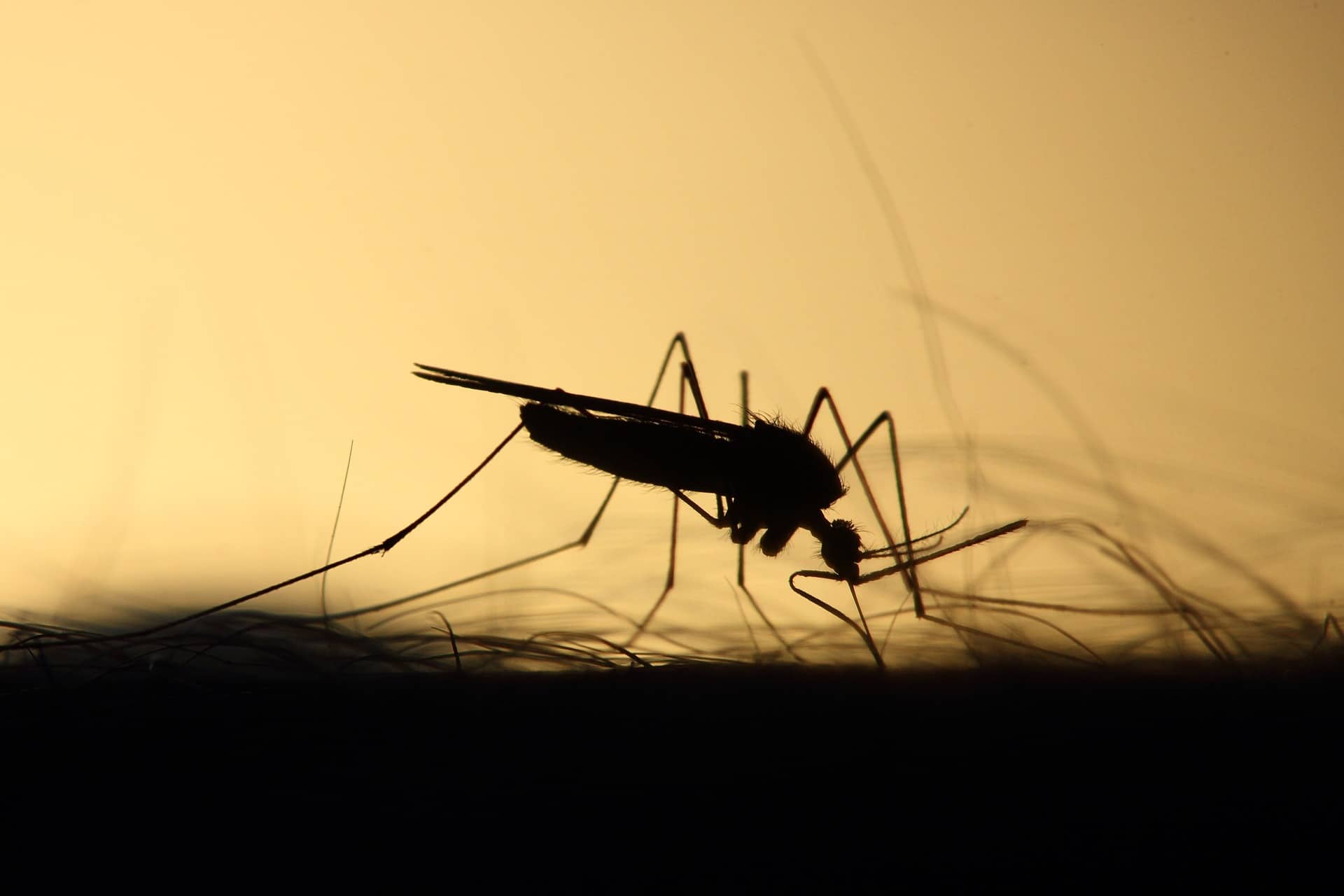
Mosquito bites are the most recognizable, resulting in small, raised, itchy bumps that appear minutes after feeding. The warm, wet summers in the Lehigh Valley, NEPA, and Western NJ make mosquitoes extremely active from late spring through early fall.
While most bites are harmless, mosquitoes in the region can carry West Nile virus.
2. Spiders
Most hard-to-identify insect bites are mistakenly called spider bites. The fangs of most spiders are too small to break the skin, and their venom is usually not harmful to humans. When they do bite, symptoms usually include mild pain, redness, and slight swelling.
However, poisonous spiders like black widows (found occasionally in PA) or brown recluses (uncommon but possible due to travel) can deliver medically significant bites requiring immediate care.
If you are bitten by a black widow or brown recluse spider, call your doctor right away.
3. Ticks
Ticks thrive in the wooded areas of Monroe, Pike, Northampton, Warren, and Sussex counties. Bites are typically painless, but some ticks transmit diseases—including Lyme disease, anaplasmosis, ehrlichiosis, babesiosis, and Rocky Mountain spotted fever.
Early symptoms of tick-borne illness may include fever, headaches, joint pain, fatigue, or rashes such as the classic “bull’s-eye” pattern. Any suspected infected tick bite requires medical evaluation.
4. Bedbugs
Bed bugs hide in mattresses, furniture, baseboards, and upholstery. Their bites create clusters or lines of small red bumps, often with itching or irritation. Severe cases may cause blistering, swelling, or secondary infections from scratching.
5. Biting Fly Bites
Pennsylvania and New Jersey’s wetlands and farmlands attract black flies, deer flies, and horse flies—each capable of painful bites. Unlike mosquitoes, these flies cut the skin before feeding, often resulting in swelling, burning sensations, and prolonged irritation. Some biting flies can transmit pathogens, though infections are uncommon.
What Are the Top Stinging Insects in Pennsylvania and New Jersey?
In addition to bug bites, you may also encounter stings from bees, wasps, and yellow jackets that could be mistaken for bug bites.
1. Bee Stings
A bee injects a type of venom into the skin when it bites. A person who is not allergic to a bee sting will typically experience sudden, sharp pain at the site, which lasts for a few seconds, and a swollen, red mark that can be itchy or painful.
2. Wasp Stings
Like bees, wasps inject venom when they puncture a person’s skin. Wasp stings are characterized by a swollen red lump, usually with a small white center (about the size of a pen tip) at the contact site.
3. Yellow Jacket Stings
Yellowjacket stings are very painful. If you are not allergic to yellow jacket venom, symptoms include pain, redness, and swelling at the site. It can take a few hours for these symptoms to subside.
Dangerous Bites and Stings: What to Watch For
While most insect bites cause only temporary irritation, those who are allergic may experience severe reactions. In addition, certain insects inject potent venom or transmit disease.
Tick Bites
Ticks are the number one vector of Lyme Disease, Alpha Gal Syndrome, and Rocky Mountain Spotted Fever–all of which can drastically affect your quality of life.
If a tick bites you, send the tick to a medical lab for testing to rule out any potential diseases.
Brown Recluse Bites (Rare but Possible)
Brown recluse spiders are not native to PA or NJ, but they occasionally appear in transported goods. Their bites often feature:
- A pale or bluish center
- A sunken or flat wound
- Delayed pain that worsens over hours
Seek medical help immediately, as symptoms can include pain at the site of the bite, malaise, confusion, and other neurological symptoms.
Black Widow Bites
Black widows prefer dark, damp areas such as basements, sheds, or woodpiles. Bites cause intense burning and may lead to muscle spasms, nausea, abdominal pain, or tremors. Children are especially vulnerable and need urgent medical attention.
How to Treat Insect Bites
Treating insect bites effectively starts with choosing the right remedy for the type of bite or sting you’re dealing with. While topical creams and oral medications can provide quick relief, it’s helpful to keep a small kit of natural and over-the-counter treatments at home so you’re prepared for anything.
Some of the most reliable, easy-to-use remedies include:
- Honey: Naturally antibacterial and soothing, honey can reduce swelling and ease discomfort from mild bites and stings.
- Witch hazel: A gentle, widely effective remedy that reduces redness, itchiness, and inflammation. Apply with a cotton ball directly to the affected area.
- Tea tree oil: More potent than witch hazel, tea tree oil works well for intense mosquito, ant, or fly bites. Because of its strong antimicrobial properties, it’s also useful for treating head lice. Dilution is recommended for sensitive skin.
- Allicin gel (garlic extract): A natural anti-inflammatory found in raw garlic, allicin can help calm irritation and reduce swelling.
While most insect bites fade within a few hours or days, seek medical attention immediately if you experience severe swelling, difficulty breathing, dizziness, fever, or symptoms that worsen over time. Even if you’ve never reacted before, an allergy can develop unexpectedly.
How to Prevent Insect Bites at Home
While no home can be completely insect-proof, reducing attractants and minimizing contact points goes a long way toward preventing bites and stings. Most insects enter homes looking for food, moisture, shelter, or warmth, so simple habit changes and a bit of home maintenance can dramatically lower your risk.
Reduce indoor attractants
- Keep counters, floors, and pantry shelves free of crumbs and sticky residue.
- Store all dry goods—especially sugar, flour, cereal, and pet food—in airtight containers.
- Empty trash regularly and use bins with tight-sealing lids.
Eliminate moisture sources
- Repair leaking faucets, pipes, and appliances.
- Run a dehumidifier in damp basements where spiders, silverfish, and mosquitoes thrive.
- Keep gutters clear to prevent standing water around the foundation.
Seal common entry points
- Replace torn window screens and install door sweeps.
- Seal cracks around siding, foundation gaps, and openings around utility lines.
- Use fine mesh covers on attic vents and exhaust fan openings.
Maintain your yard
- Keep grass trimmed and remove leaf piles—prime hiding spots for ticks and spiders.
- Store firewood at least 20–30 feet away from the home.
- Reduce standing water by clearing gutters, unclogging drains, and refreshing bird baths regularly.
Use preventative barriers and repellents
- Apply EPA-approved yard sprays as a barrier against ticks and mosquitoes.
- Install yellow “bug light” bulbs on porches to reduce nighttime insect activity.
- Consider routine seasonal pest control for long-term prevention of ticks, spiders, stinging insects, and biting flies.
These simple steps help create an environment that’s less attractive to insects and less likely to expose your family to stings, bites, and the health issues that can follow.
FAQs
How can I tell what bug bit me?
Examine the size, pattern, and location of the mark. Mosquitoes leave raised itchy bumps, ticks remain attached, and bed bugs usually leave clusters or lines. A doctor or pest professional can help identify unclear bites.
When should I see a doctor for a bite or sting?
Seek care if you develop a fever, spreading rash, difficulty breathing, significant swelling, or symptoms that worsen after 24–48 hours.
Are tick bites always dangerous?
No, but ticks in PA and NJ frequently carry Lyme disease. If you develop flu-like symptoms or a rash near the bite, seek medical attention immediately.
How can I prevent insect bites at home?
Reduce standing water, keep vegetation trimmed, seal gaps around windows and doors, and maintain indoor cleanliness. Pest professionals can provide seasonal protection.
Are bed bug bites harmful?
They’re not medically dangerous, but bites can cause severe itching, allergic reactions, and emotional stress. Bed bug infestations require professional treatment.
Do spiders bite humans often?
Rarely. Most spiders avoid humans and bite only when threatened or trapped against skin.
How Much Does Bed Bug Treatment Cost in PA and NJ?
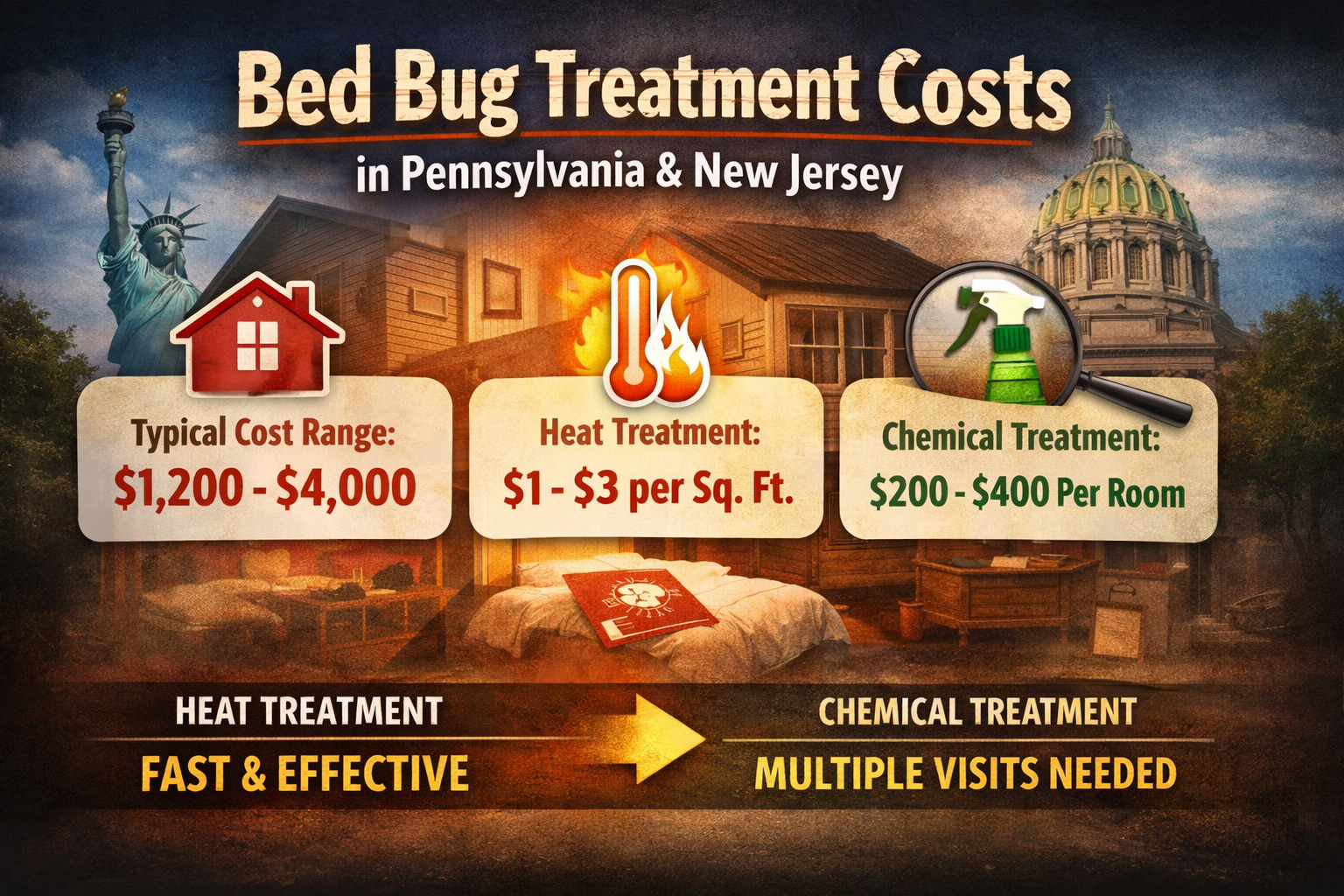
Bed bug treatment costs in Pennsylvania and New Jersey range from $1,200 to $4,000 for most single-family homes, depending on property size, infestation severity, and treatment method.
According to Angi, the national average bed bug treatment cost is $2,500, with heat treatment typically costing $1 to $3 per square foot.
Heat treatment is the preferred method used by our Pennsylvania and New Jersey technicians for large infestations because it eliminates bed bugs at all life stages in a single visit–-less than 24 hours for eradication.
Chemical treatments cost less per visit but require multiple applications spaced two weeks apart, making them better suited for smaller infestations confined to a single room.
Companies like The Pest Rangers include the cost of K9 bed bug inspections in the final service price, while others charge for inspections and follow-up services separately.
This guide breaks down bed bug treatment pricing by property type, treatment method, and geographic factors specific to Pennsylvania and New Jersey. It explains what impacts your final cost and what professional treatment includes.
Bed Bug Treatment Cost in Pennsylvania and New Jersey
Bed bug treatment rates tend to be slightly higher in New Jersey, but vary by property due to labor rates, square footage, and the prevalence of multi-unit housing, where infestations spread more rapidly.
Average Bed Bug Treatment Cost in Pennsylvania
Pennsylvania homeowners typically pay $1,200 to $3,500 for bed bug treatment, depending on the square footage.
- $1,200–$2,500 for apartments or small homes under 1500 square feet
- $2,000–$3,500+ for larger single-family homes over 2000 square feet
Prices are generally higher in urban areas like the Lehigh Valley and Bucks County than in Northeast Pennsylvania.
Larger properties will also drive up expenses due to increased labor and time invested in treatment.
Average Bed Bug Treatment Cost in New Jersey
New Jersey homeowners typically pay $1,500 to $4,000 for bed bug treatment, with prices varying by property type and square footage.
- $1,500–$3,000 for condos and townhomes under 1500 square feet
- $2,500–$4,000+ for larger properties over 2000 square feet
Prices for treatments in New Jersey are generally higher in urban areas like Trenton, where shared housing allows infestations to spread more quickly. Areas outside Camden tend to be more expensive due to increased demand for residential and commercial properties.
What Determines Bed Bug Treatment Pricing
Several variables impact the final cost of bed bug treatment. Property size and infestation severity are the primary factors, but clutter level, multi-unit housing considerations, and follow-up service requirements also affect pricing.
Property Size
Square footage directly determines labor time and the amount of equipment required.
Heat treatment costs $1 to $3 per square foot, according to Angi, with an average 1,200-square-foot apartment costing between $1,200 and $3,600 for heat treatment. A 2,500-square-foot home costs $2,500 to $7,500, though most Pennsylvania and New Jersey providers cap residential pricing at $3,500 to $4,000 regardless of square footage.
The number of rooms requiring treatment also impacts cost. If bed bugs are isolated to one or two bedrooms, your inspector may only recommend chemical treatment confined to infested rooms.
The Pest Rangers charges approximately $650 per room for liquid chemical treatment, making targeted treatment more affordable for localized infestations.
Infestation Severity
Light infestations confined to one or two pieces of furniture require less labor and fewer heat cycles. Severe infestations where bed bugs have spread throughout the home, into wall voids, and behind baseboards require more intensive treatment.
Bed bugs reproduce rapidly–a single fertilized female can lay 200 to 500 eggs over her lifetime. Therefore, detecting an infestation early can significantly lower the final cost of bed bug treatment.
Clutter Level
Heat treatment requires clear pathways for hot air circulation.
Clutter blocks airflow and creates cold spots where bed bugs can survive treatment. Homes with excessive clutter require additional prep time: moving furniture away from walls, removing items from closets, and clearing floor space.
Some pest control companies charge additional prep fees for heavily cluttered properties. Others provide a detailed preparation checklist and require homeowners to complete prep work before the scheduled treatment date.
Failure to properly prepare can result in treatment failure and the need for repeat visits.
Multi-Unit Housing
Apartments, condos, and duplexes present unique challenges for bed bug exterminators.
Bed bugs travel through wall voids, electrical conduits, and shared plumbing. Treating a single unit without inspecting adjacent units allows the infestation to persist.
Professional treatment in multi-unit buildings requires coordination with property management and inspection of neighboring units.
According to the National Pest Management Association, bed bugs are among the most difficult pests to control in multi-unit housing due to constant reinfestation from untreated neighboring units. Treatment costs in apartment buildings typically exceed those in single-family homes due to coordination and additional inspection requirements.
Follow-Up Services
Heat treatment eliminates bed bugs in one visit when performed correctly. However, follow-up inspections 7 to 14 days after treatment confirm eradication and catch any surviving eggs that may have been in areas that did not reach lethal temperatures.
Some pest control companies include one follow-up inspection in their base price. Others charge $75 to $200 for follow-up visits.
Chemical treatment always requires multiple visits spaced two weeks apart, with each visit costing $200 to $400 per room according to Angi. Clarify what follow-up services are included when comparing quotes.
Heat Treatment vs. Chemical Treatment Cost Comparison
Heat treatment and chemical treatment are the two primary methods for bed bug elimination.
Heat treatment costs more upfront but typically resolves infestations in one visit. Chemical treatment costs less per visit but requires multiple applications, often making it more expensive overall.
Heat Treatment
Heat treatment involves raising the temperature of the entire property or individual rooms to 120°F to 140°F for 6 to 10 hours. At these temperatures, bed bugs at all life stages die within minutes.
- Average cost: $1 to $3 per square foot (Angi), or $2,200 to $2,700+ for whole-home treatment (The Pest Rangers)
- Time required: 6 to 10 hours for treatment, plus 2 to 4 hours for setup and teardown
- Effectiveness: Kills eggs, nymphs, and adults in a single treatment
- Completion: Typically, one visit eliminates the infestation when prep work is completed properly
Heat treatment is preferred in Pennsylvania and New Jersey because it can be done in a single visit, produces no chemical residue, and does not contribute to pesticide resistance. The upfront cost is higher, but the total cost is typically lower than multi-visit chemical treatment programs.
Chemical Treatment
Liquid chemical treatment uses EPA-registered insecticides applied to cracks, crevices, mattress seams, bed frames, and other areas where bed bugs hide.
Multiple applications are required because eggs are resistant to most pesticides, and newly hatched nymphs must be targeted in follow-up visits.
- Average cost: $200 to $400 per room per visit (Angi), or ~$650 per room (The Pest Rangers)
- Time required: 1 to 3 hours per visit
- Effectiveness: Kills adults and nymphs; eggs often survive and require follow-up treatment
- Completion: Typically requires 2 to 3 visits spaced 10 to 14 days apart
Chemical treatment costs less per visit but more overall when multiple visits are required.
Commercial Pest Control Costs in PA and NJ
Residential and commercial properties require different treatment approaches and pricing structures. Whereas homes can be treated in a single day with minimal disruption, commercial properties require phased treatment plans and extensive documentation.
Hotels, motels, assisted living facilities, and apartment buildings are the most vulnerable to bed bugs and face significantly higher treatment costs. Pricing depends on room count, occupancy rates, and whether treatment can be phased or must be completed simultaneously.
Hotels typically treat infested rooms individually at $400 to $1,200 per room, depending on size and furnishings.
Apartment buildings may require treating multiple units simultaneously to prevent migration, with costs scaling with the number of infested units and buffer units on shared walls.
Commercial bed bug treatment includes additional coordination: notifying tenants or guests, scheduling around occupancy, and providing documentation for regulatory compliance or litigation defense. These factors increase labor time and administrative costs beyond residential treatment.
What’s Included in a Bed Bug Treatment Quote?
Not all bed bug treatment quotes include the same services.
Professional treatment should always include an initial inspection, temperature monitoring during heat treatment, and a written preparation checklist. Some companies include follow-up inspections; others charge separately.
Standard inclusions:
- Full property inspection to identify infested areas and assess severity
- Temperature monitoring sensors placed throughout treatment areas to verify lethal temperatures are reached
- Industrial heating equipment capable of raising room temperatures to 120°F minimum
- Treatment of all affected rooms and common pathways where bed bugs may travel
- Written preparation checklist detailing what must be removed, what can remain, and how to prepare bedding and furniture
Optional or separately-priced services:
- Mattress encasements to trap any surviving bed bugs and prevent future infestations
- Follow-up inspection 7 to 14 days after treatment to confirm elimination
- Retreatment guarantee if bed bugs are detected within 30 to 60 days (terms vary by company)
Always confirm what follow-up services are included before accepting a quote.
The lowest-priced quote may exclude follow-up visits or retreatment guarantees that other companies include, making direct price comparisons misleading.
FAQs
Why do bed bug treatment costs vary so much?
Treatment costs vary because every infestation presents different challenges. A 1,200-square-foot apartment with bed bugs isolated to one bedroom costs significantly less than a 2,500-square-foot home where bed bugs have spread to multiple rooms, furniture, and wall voids. Property size, infestation severity, clutter level, and treatment method all impact the final price.
Do heat treatments cost more than chemical treatments?
Heat treatments cost more per visit ($2,200 to $2,700+ for whole-home treatment) but typically eliminate infestations in one visit. Chemical treatments cost less per visit (~$650 per room) but require 2 to 3 applications spaced two weeks apart, often resulting in a higher total cost. Heat treatment also helps prevent pesticide resistance, thereby reducing the effectiveness of chemical treatments.
Does the size of the home affect cost?
Yes. Larger homes require more equipment, longer treatment times, and more labor. Heat treatment typically costs $1 to $3 per square foot, according to Angi. A 1,500-square-foot home costs $1,500 to $4,500 for heat treatment, while a 2,500-square-foot home costs $2,500 to $7,500, though most Pennsylvania and New Jersey providers cap residential pricing between $3,500 and $4,000.
Do multi-unit buildings cost more to treat?
Yes. Apartments, condos, and duplexes require inspections of adjacent units to prevent reinfestation from neighboring units. Treatment must be coordinated with property management and scheduled around tenant occupancy. These factors increase labor time and complexity, raising costs above single-family home treatment.
Are follow-up visits usually included?
It depends on the company and the treatment plan. Some providers include follow-up inspections and retreatments in their pricing, while others charge separately. Always confirm what is included before signing an agreement.
How much do bed bug inspections cost?
Bed bug inspections cost $75 to $200 in Pennsylvania and New Jersey, according to Angi. The Pest Rangers charges $95 for inspections, which is applied toward the treatment cost if bed bugs are confirmed. Some companies offer free visual inspections but charge for more thorough canine detection inspections, which cost $300 to $600.
Should I get multiple quotes before choosing a provider?
Yes. Always compare quotes to ensure you find the service that best suits your needs. Remember, the cheapest option may not be the best, as it can omit essential steps to ensure the problem is addressed.

How to Use Bait Stations for Rodents in NJ and PA
Bait stations are one of the most effective tools for controlling rodents in Pennsylvania and New Jersey, especially as colder fall and winter temperatures drive mice and rats indoors across the Lehigh Valley, North Jersey suburbs, and dense urban corridors like Newark and Philadelphia.
Unfortunately, after two decades of field experience, one of the most common mistakes our technicians have witnessed is improper use of mouse traps and bait.
Most homeowners undermine their own efforts by placing bait stations in the wrong locations or using insufficient quantities, which can make small infestations worse.
Bait stations work by housing rodenticide bait in a tamper-resistant enclosure that prevents children and pets from accessing the poison while allowing target rodents to enter and feed.
The EPA requires tamper-resistant bait stations for all consumer rodenticide products sold after 2011, and professional-grade stations must meet even stricter performance standards for outdoor use.
This guide explains how bait stations work, where to place them for maximum effectiveness, how to choose between refillable and disposable models, and what a monitoring schedule can do to prevent infestations from progressing.
How Do Bait Stations Work?
A bait station is a plastic or metal enclosure designed to hold rodenticide bait while restricting access to non-target animals.
The station contains entrance holes sized to admit mice and rats but exclude larger animals. Internal baffles and locking mechanisms prevent children from reaching the bait even if they attempt to open the station.
Once placed correctly around your home or business, these bait stations will attract rodents looking for food and shelter from predators. When they enter the station, they will find pre-baited traps that contain poison pellets or blocks containing anticoagulant poisons, such as bromadiolone or brodifacoum–both lethal when ingested by rodents over time.
Most anticoagulant baits take three to five days to kill rodents after the first feeding. This delayed mortality prevents bait shyness—a learned avoidance behavior in which rodents associate illness with a food source. The delay allows multiple rodents to feed before any die, increasing overall kill rates.
Common Types of Bait Stations
The two most common types of bait stations are refillable and disposable. Disposable stations are meant for single-use, while refillable stations can be filled with different types of bait depending on what kind of rodent you’re trying to control.
Disposable bait stations provide a quick and effective solution for large infestations and are much more effective than traps and mothballs for mice. However, traps may not be as effective for curtailing a large-scale infestation.
These traps can be strategically placed around your property to ensure maximum coverage and better overall results. Once all traces of previous use have been removed (including any dead animals), simply swap out the old station for a new one–no refills necessary. This approach will enable you to regain control of the situation quickly.
The EPA classifies bait stations into four tiers based on tamper resistance and weather resistance. Tier 1 stations are tested to resist tampering by children and dogs, resist weather exposure, and can be used indoors and outdoors within 50 feet of buildings. Tier 4 stations lack tamper-resistance testing and are restricted to indoor use in areas inaccessible to children and pets.
Refillable vs. Disposable Bait Stations
Bait stations are sold as either refillable or single-use disposable units. The correct choice depends on infestation severity, property size, and whether the station will be used for ongoing prevention or one-time treatment.
Refillable Bait Stations
Refillable stations are designed for long-term use and can be restocked with bait blocks or paste as rodents consume them. These stations cost more upfront but provide better value for ongoing rodent control programs or properties with recurring infestations.
Advantages:
- Lower cost per treatment over time compared to repeated purchases of disposable units
- Accommodate different bait types (blocks, soft baits, or liquid baits in some models)
- More durable construction suitable for outdoor use and year-round placement
- Larger bait capacity reduces refill frequency
Disadvantages:
- Higher initial cost
- Require regular inspection and maintenance
- Must be cleaned periodically to prevent mold growth on uneaten bait
Disposable Bait Stations
Disposable stations come pre-loaded with bait and are discarded once the bait is consumed or contaminated. These work well for minor infestations in small properties where rodent activity is isolated to one or two rooms.
Advantages:
- Lower upfront cost
- No maintenance or refilling required
- Convenient for one-time treatments in low-risk areas
Disadvantages:
- Higher per-treatment cost for ongoing control
- Limited bait capacity may be insufficient for severe infestations
- Less durable construction not suitable for outdoor exposure
- Generate more waste than refillable models
For properties in Pennsylvania and New Jersey with recurring rodent pressure–particularly homes near wooded areas, agricultural land, or older urban neighborhoods with aging infrastructure–refillable stations provide better long-term value and more reliable protection.
What’s the Best Bait for a Bait Station?
Bait attractiveness determines whether rodents will enter the station and feed. The most effective baits combine strong odor with palatable texture and nutritional appeal.
Commercial rodenticide baits are formulated as blocks, soft paste, or pellets (pellets are restricted to professional use and prohibited in consumer products).
Block baits last longer without spoiling and work well in areas where rodents gnaw to keep their teeth trimmed. Soft paste baits are more attractive to mice because they mimic high-protein food sources but spoil faster in humid conditions.
While some sources recommend using food-based attractants like peanut butter or bacon to supplement bait stations, this is not necessary and can be counterproductive. Rodenticide baits are already formulated to be highly attractive to rodents.
Adding additional food may cause rodents to eat the supplemental bait and ignore the poison, or it may attract non-target animals.
Where Is the Best Location for a Bait Station?
Bait stations should be placed where rodent activity is likely to occur. Rodents follow predictable travel patterns along walls, behind appliances, and through structural pathways.
Follow these placement guidelines to maximize station effectiveness:
- Position stations against walls with the entrance holes facing the wall. Rodents travel along edges for protection and rarely cross open spaces.
- Place stations 8 to 12 feet apart along walls where rodent activity is evident. For severe infestations, reduce spacing to 6 feet.
- Put stations behind appliances, under sinks, along baseboards, in corners, and near entry points like gaps around pipes or utility lines.
- Do not place stations in areas accessible to children or pets unless using Tier 1 tamper-resistant models designed for such locations.
- Secure stations to prevent movement. Rodents are cautious and may avoid stations that shift or tip when touched. Use cable ties, screws, or weighted stations.
- For exterior placements, position stations within 50 feet of the building along the foundation perimeter, near downspouts, in window wells, and around utility meter boxes.
Avoid placing bait stations in open areas, on countertops, or in the middle of rooms. Rodents will not use them. The goal is to intercept rodents along their established travel routes, not to lure them into new areas.
Common Mistakes When Using Bait Stations
Bait stations can be very effective for controlling rodents, but only if used correctly. Avoiding common mistakes will ensure they’re doing the job they’re intended for, preventing you from wasting valuable time and money.
Some of the most common mistakes made when using bait stations are:
- Placing bait stations in the open, rather than near rodent nesting and travel areas
- Using too few bait stations
- Using bait stations without addressing entry points, clutter, or food sources
Remember, bait stations are simply tools that need to be used properly. It’s up to you or the pest control specialist to place them in the right areas, along with taking other steps to ensure they work to reduce a growing pest population.
Common Mistakes That Reduce Bait Station Effectiveness
Most bait station failures result from placement errors, insufficient quantities, or failure to address conducive conditions that allow rodents to thrive regardless of baiting efforts.
Placing Stations in Open Areas
Rodents avoid open spaces where they are exposed to predators. Stations placed in the middle of floors, on open shelves, or away from walls will not be used. Always position stations along walls, in corners, or behind objects where rodents naturally travel.
Using Too Few Stations
A single bait station is rarely sufficient, even in small homes. Rodents establish multiple feeding sites and will not travel long distances to access a single station, especially when easier food sources are available. Use at least one station per room showing rodent activity, and increase density in heavily infested areas.
Ignoring Conducive Conditions
Bait stations address the rodent population but do not eliminate the conditions that allowed the infestation to develop. If food is left accessible, entry points remain unsealed, and clutter provides harborage, rodent populations will recover even after successful baiting.
Bait stations must be combined with sanitation, exclusion, and habitat modification to achieve long-term control.
Failing to Monitor Regularly
Bait stations do not work autonomously. Stations left unchecked may run out of bait, become contaminated, or develop mechanical failures that prevent rodents from accessing the bait. Regular inspection ensures stations remain effective throughout the treatment period.
How Long Does It Take to See Results
If you use bait stations correctly, you can start to see results in as little as a week. That said, the size of the home and the extent of the infestation will directly affect how long it takes to eliminate an infestation.
In small homes with minor infestations, you may be done with the problem in just a few weeks, while larger infestations in bigger properties can take months to resolve.
Expect to see increased rodent activity during the first week of baiting as rodents encounter stations and begin feeding. Visible activity typically declines after two weeks as the rodent population decreases.
Continue monitoring for at least 4 weeks after the last signs of activity to confirm the infestation has been eliminated and that no new rodents have entered.
FAQs
Are bait stations effective for mice?
Yes. Bait stations are highly effective for mice when properly placed along walls and in areas with confirmed rodent activity. Stations provide a controlled method of delivering rodenticide while preventing access by children and pets. Effectiveness depends on using sufficient quantities, maintaining fresh bait, and addressing entry points through exclusion work.
Do bait stations attract more mice?
Yes, bait stations can draw more mice to the areas where they are placed. Often, this is a good way to gauge how extensive your infestation is, though it may attract more mice from elsewhere than you expected.
How do mouse bait stations work?
Bait stations attract rodents already present in or near the structure, but they do not draw rodents from distant locations. If you see increased activity after placing bait stations, it indicates the infestation was larger than initially apparent, not that stations are attracting new rodents from outside. This increased visibility is temporary and typically resolves within two weeks as the rodent population declines.
Are mouse bait stations better than traps?
Both traps and bait stations offer distinct advantages. Traps deal with curious rodents in easily accessible areas, while bait stations are better for cautious rodents that remain hidden. Both require proper monitoring and placement to work correctly, though.
Is rodent bait safe for pets and children?
Professional bait stations are built to be tamper-resistant to reduce the risks of harming pets or children. However, they still need to be placed properly and monitored to ensure only rodents can access them.
How often should bait stations be checked?
We recommend that bait stations be checked every 2 to 4 weeks. It’s best to check on them more frequently for severe infestations and, if pets or children are present, to ensure they haven’t tampered with them.
Can mice avoid bait stations?
Yes. Some rodents will avoid unfamiliar objects like bait stations, which is another reason it’s important to take multiple approaches when eliminating a pest problem.
How Much Does Pest Control Cost? Price Guide
Pest control costs in Pennsylvania and New Jersey range from $225 to $895 for one-time treatments, depending on pest type and infestation severity.
Ongoing home protection plans cost $45 to $90 per month, based on property size, and cover 40+ common pests with three scheduled visits per year, plus unlimited re-service as needed.
Specialty treatments vary significantly based on infestation severity and treatment type. For example, bed bugs run $650 per room for chemical treatment or $2,200 to $2,700+ for whole-home heat treatment. Bat exclusion can cost up to $3,000, while minor ant issues cost as little as $225.
This guide breaks down The Pest Rangers’ pricing structure for New Jersey and Pennsylvania property owners by service type. It explains what drives cost differences, and shows you how to evaluate whether ongoing protection or one-time treatment makes more financial sense for your situation.
Average Pest Control Plan Costs in Pennsylvania and New Jersey
Pest control pricing in the Mid-Atlantic region follows predictable patterns based on service frequency and treatment scope. One-time emergency treatments cost more per visit than maintenance plans, but ongoing plans provide better long-term protection and lower per-visit costs.
| Home Protection Plan (Ongoing Service) | Monthly Price |
| 0–2,000 sq ft | $45 – $55 |
| 2,000–3,000 sq ft | $50 – $60 |
| 3,000–4,000 sq ft | $70 – $80 |
| 4,000–6,000 sq ft | $80 – $90 |
| Larger homes / duplexes | Quoted individually |
The Pest Rangers’ Home Protection Plans include coverage against 40+ common insects and rodents, three scheduled visits per year, and unlimited re-service between scheduled visits at no additional charge.
What Determines Pest Control Pricing
The Pest Rangers calculates pricing using a combination of fixed and variable factors. Understanding these cost drivers helps you evaluate quotes and avoid overpaying.
Pest Type
Treatment complexity and labor intensity vary dramatically by species. Ants require targeted baiting and exterior perimeter treatment, while bed bugs demand heat treatment or multiple chemical applications with mattress encasements.
The following table illustrates one-time treatment costs for common pests across Eastern Pennsylvania and New Jersey.
| Pest Type | Treatment Cost |
| Ants (Small / Common) | ~$225 |
| Carpenter Ants | ~$325 |
| Pharaoh Ants | ~$475 |
| Cockroaches (German) | $395 – $795 |
| Cockroaches (American / Oriental) | $295 – $595 |
| Rodents (Mice) | $295 – $595 |
| Rodents (Rats) | $595 – $895 |
| Spiders / Occasional Pests | $225 – $350 |
| Stinging Insects (Ground Nests) | ~$225 |
| Stinging Insects (Eye-Level Nests) | ~$245 |
| Stinging Insects (Above First Floor) | $275+ |
| Bed Bugs (Liquid Treatment per Room) | ~$650 |
| Bed Bugs (Heat Treatment, Whole-Home) | $2,200 – $2,700+ |
| Bat Exclusion | Starting ~$3,000 |
| Wildlife (Raccoons, Squirrels) | Quoted after inspection |
Bed bugs and wildlife exclusion are the most costly treatments due to specialized equipment, extensive labor, and structural work.
Infestation Severity
Early detection significantly reduces treatment costs. A localized ant colony near a kitchen window can be eliminated with targeted baiting during a single visit. A cockroach infestation that spreads across multiple rooms requires whole-home treatment, follow-up inspections, and potentially multiple product applications, which can inflate the cost of service.
Property Size
Square footage directly impacts treatment time and material usage. A 1,000-square-foot apartment requires fewer products and labor than a 3,000-square-foot single-family home.
Exterior perimeter treatments scale with the foundation’s linear footage. Interior treatments scale with the number of rooms and the total area requiring coverage.
Expect to pay 30 to 50 percent more for pest control in homes over 2,500 square feet compared to homes under 1,500 square feet, assuming similar infestation levels and pest types.
Treatment Frequency
Most minor pest issues resolve in one or two visits. Severe infestations or reproductive pests like bed bugs and German cockroaches require multiple treatments spaced two to four weeks apart to target newly hatched individuals that survived the initial application.
Treatment Method
Treatment approach affects both cost and effectiveness. Common methods include:
- Chemical applications: Sprays, dusts, and granules applied to target areas and pest entry points
- Baiting systems: Gel baits, bait stations, or traps that attract pests and eliminate colonies
- Heat treatment: Whole-room heating to 120–140°F to kill bed bugs and eggs (higher cost, single-visit solution)
- Fumigation: Tent or chamber fumigation for severe termite or stored product pest infestations (highest cost)
- Exclusion work: Sealing entry points, installing door sweeps, and repairing screens to prevent pest access
Heat treatment for bed bugs costs more upfront but often eliminates the infestation in a single day. Chemical treatment costs less per visit but typically requires two to three applications.
The lower per-visit cost can result in a higher total cost if multiple treatments are needed.
Geographic Location and Seasonality
Climate and regional pest pressure influence service frequency. Southeastern Pennsylvania and southern New Jersey experience longer warm seasons, extending mosquito and tick activity compared to the Poconos or northwestern Pennsylvania.
Urban areas like Philadelphia and Trenton see higher rodent populations due to density and available food sources.
Service rates also vary by market. Companies operating in metropolitan areas typically charge 10 to 20 percent more than providers in rural counties due to higher operating costs, though competition in urban markets can moderate pricing.
DIY Vs. Professional Pest Control: Cost vs. Effectiveness
Over-the-counter pest control products cost $10 to $50 per treatment and can resolve minor, localized problems. A can of aerosol insecticide may eliminate visible ants in a kitchen, but it is no match for a fully established colony inside your walls.
In addition, homeowners commonly run into these mistakes when treating pests on their own.
- Using foggers or bug bombs that push cockroaches deeper into wall voids rather than eliminating them
- Applying insufficient product or treating only visible areas while missing nests and harborages
- Choosing the wrong product for the pest species or life stage
- Misidentifying the pest entirely, wasting time and money on ineffective treatments
Professional pest control companies have access to commercial-grade products unavailable to consumers, understand pest biology and behavior, and know where to apply treatments for maximum effectiveness.
We routinely service homes where DIY efforts cost $200 to $300 in retail products but failed to resolve the issue, money that could have paid for professional treatment from the start.
Warning: Bed bugs, termites, and cockroaches should always be handled by licensed professionals. These pests spread quickly, cause significant damage or health risks, and resist most consumer products. Attempting DIY treatment on these species typically makes the problem worse and more expensive to fix later.
Commercial Pest Control Costs in PA and NJ
Commercial pest control in Pennsylvania and New Jersey costs $50 to $1,500 per month, depending on property size, industry, and regulatory requirements. A 2,000-square-foot retail shop may pay $75 to $150 per month for routine service, while a 50,000-square-foot warehouse or food processing facility can exceed $1,000 per month for comprehensive integrated pest management programs.
Restaurants, food retailers, healthcare facilities, and hospitality businesses face strict regulatory standards and regular health inspections. Pest violations lead to failed inspections, fines, mandatory closures, and reputational damage.
The cost of a monthly pest control program is often negligible compared to the financial and operational impact of a single failed inspection or customer complaint tied to visible pests.
Commercial programs include routine inspections, monitoring, treatment, documentation, and corrective action reports required for regulatory compliance. These services are not optional for businesses operating in regulated industries.
The ROI of Preventive Pest Control
Pests like termites cause over $5 billion in property damage annually in the United States.
Wood-destroying pests like termites and carpenter ants damage wood furniture and framing components, threatening the structural integrity of your home. Rodents chew through wiring, insulation, and structural materials.
Repairing rodent-damaged wiring or attic insulation costs $1,500 to $4,500. Replacing carpenter ant-damaged floor joists or support beams can cost $2,000 to $10,000, depending on the extent of the damage.
A home protection program costs $540 to $1,080 per year, depending on property size, saving you thousands of dollars in potential repairs.
Beyond property damage, pest infestations create health risks. Cockroaches and rodents spread allergens that trigger asthma and respiratory issues. Ticks carry Lyme disease. Mosquitoes transmit West Nile virus and Eastern equine encephalitis, which require expensive medical treatment and lost productivity that far exceed the cost of preventive services.
When compared to the negative consequences of a pest infestation, preventive pest control is not an expense. Risk mitigation protects property value, avoids repair costs, and reduces health risks.
Remember, when you see pests, you are seeing only a fraction of the population. Early professional intervention costs less and works better than waiting until the problem is severe.
FAQs
Do I really need monthly pest control service?
Monthly service is not required for all properties, but it provides the best protection for homes with recurring issues, properties near wooded areas, or houses with conducive conditions like crawl spaces or damp basements. Quarterly service is sufficient for most homeowners. Monthly plans are recommended during active infestations or for properties with persistent pest pressure.
How often should I schedule pest control treatments?
The Pest Rangers’ standard home protection plans include three scheduled visits per year, which align with seasonal pest cycles and provide consistent year-round coverage. Active infestations may require more frequent visits — monthly or bi-weekly — until the pest population is eliminated.
How much does recurring pest control cost per month?
Residential recurring service through The Pest Rangers costs $45 to $90 per month based on property size, covering general household pests with three scheduled visits per year plus unlimited re-service. Commercial recurring service ranges from $50 to $1,500 per month depending on property size, industry, and regulatory compliance requirements.
Do pest control prices include follow-up visits?
Most professional pest control companies include follow-up visits as part of their service guarantee for active infestations. Preventive maintenance plans typically include scheduled quarterly visits plus emergency callback service at no additional charge if pests appear between scheduled treatments.
Does home size affect pest control cost?
Yes. Property size directly impacts the amount of product required, treatment time, and labor costs. Pest control companies calculate pricing based on square footage and the linear footage of exterior perimeter requiring treatment. Larger homes take longer to inspect and treat, require more material, and present more potential entry points and harborage areas.
How can I reduce pest control costs?
The most cost-effective strategy is prevention. Seal cracks and gaps around windows, doors, and foundation penetrations. Eliminate standing water, fix leaking pipes, and reduce moisture in basements and crawl spaces. Schedule annual inspections to catch problems early before they require expensive emergency treatment.

Good Bugs vs Bad Bugs. Is This Really A Thing?
Not all bugs are bad. While maybe not the most pleasant things to look at, the reality is that bugs exist in a balanced ecosystem. Many have roles that benefit the world around them, qualifying them as good bugs.
Unfortunately, not all bugs are good either. Many bugs in Pennsylvania and New Jersey are invasive pests that carry disease, contaminate food stores, destroy property, and generally disrupt the ecosystems they’ve invaded.
While we can’t tell you everything there is to know about the thousands of insects that live in Northeastern Pennsylvania, we can help you tell the difference between good bugs and bad bugs so you can better protect your home and garden.
What Makes a Bug Good?
A “good” bug supports your yard’s ecosystem instead of damaging it. Beneficial insects help control pest populations, support plant growth, and maintain soil health without the use of chemicals or human intervention.
Some beneficial insects act as natural predators or parasites that keep destructive pests in check. Others play a critical role in pollination, which helps plants produce flowers, fruit, and seeds.
Certain species also improve soil quality by breaking down organic matter and returning nutrients to the ground, where plants can reuse them.
Good bugs reduce the need for pesticides, support healthier plants, and help your yard stay balanced naturally.
5 Examples of Good Bugs in PA and NJ
Below are five examples of beneficial insects and how they contribute to a healthier outdoor environment.
1. Honeybees and Bumblebees
Bees are essential pollinators that help plants reproduce by transferring pollen between flowers. This process supports fruit production, seed development, and overall plant health.
While bees can sting, they are not aggressive and typically only do so when threatened.
Their populations have declined due to pesticide use, habitat loss, and climate change, making bee protection critical to maintaining healthy ecosystems and food supplies.
2. Ladybugs
These tiny little beetles may not seem like the killing type, but they can eat up to 5,000 insects in a lifetime. Bright and colorful, ladybugs will eat mites, mealybugs, and aphids—all the nasty insects that like to attack your garden!
3. Spiders
Spiders may not be everyone’s favorite arachnid, but they are very adept hunters that are ultimately good for the local environment. They can kill a lot of different pests that are harmful to humans and plants.
Some spiders may be dangerous for humans, but the more common spiders you encounter daily would rather stay out of sight, silently keeping insect populations under control.
4. Earthworm
While not technically insects, earthworms are invertebrates that are good to have around. These slimy creatures help mix organic matter into the soil, improving its structure and water infiltration.
While too many worms can be a problem, soil diversity can help your garden grow.
5. Praying Mantis
A praying mantis hunts pests that damage flowers and crops. Tiny, yet terrifying, these creatures can provide your garden with ultimate protection.
What Makes a Bug Bad?
A “bad” bug is one that damages plants, spreads disease, contaminates living spaces, or creates health and safety risks for people and pets.
In Pennsylvania and New Jersey, certain insects thrive due to seasonal humidity, dense vegetation, and closely built neighborhoods.
These pests may destroy gardens and landscaping, infest homes, or bite and sting humans. Some carry bacteria or allergens, while others multiply quickly and become difficult to control once established indoors.
Recognizing which insects pose real risks helps homeowners act early and prevent larger infestations.
5 Examples of Bad Bugs in PA and NJ
Below are five common harmful bugs to watch for in PA and NJ, and why they cause problems.
1. Mosquitos
Mosquitoes require blood meals to reproduce, which puts humans and animals at risk.
In PA and NJ, mosquitoes are known carriers of diseases such as West Nile virus and other mosquito-borne illnesses.
Even when disease transmission does not occur, repeated bites cause itching, allergic reactions, and increased outdoor discomfort, making mosquito control an important health and quality-of-life concern.
2. Japanese Beetles (or June bugs)
While not as dangerous as mosquitoes, Japanese beetles can be devastating to your vegetation. They feed on leaves, flowers, fruit, and more than 300 plant species. Not only that, but they can also kill the grass.
3. Grasshoppers
Grasshoppers are extremely common insects that seem harmless, but they can wreak havoc on crops. These jumping insects can be devastating if they swarm in farmlands or in your backyard.
4. Ladybirds (Asian Lady Beetles)
While ladybugs may be helpful, don’t confuse them with Asian lady beetles. Unlike ladybugs, this invasive species is an annoying, overwintering pest that can sneak into your home, leave yellow, foul-smelling streaks everywhere, and even bite humans.
5. Cockroaches
Cockroaches go where the food is, and they bring with them some nasty diseases. While they can be found outside, their goal is to make it indoors and find a comfortable place to settle down.
Once inside, they can spread disease and allergens, contaminating food sources and posing a real threat to humans.
How to Distinguish Between Good Bugs vs Bad Bugs
Learning to identify the species above is a great way to start telling the difference between good and bad bugs. However, they are only a small portion of the local bug population.
To identify if an unknown bug is beneficial or detrimental, simply look at how it interacts with the world around it:
- Good bugs benefit the ecosystem. They control insect populations, pollinate plants, and improve soil. They rarely invade homes and prefer to live outdoors.
- Bad bugs cause mostly damage to the world around them. They invade homes, destroy plants, spread disease, and contaminate food.
- Simple rule: Bugs that stay outside and generally don’t trouble humans or plants are good bugs, while those that bite and invade homes are pests you need to eliminate.
How Do I Get Rid of The Bad Bugs?
If you want to get rid of the bad bugs while encouraging the good kind, there are a few things you can do to protect your home or garden.
- Encourage natural predators: Plant flowers and fruits that attract bats, birds, bees, frogs, and dragonflies, which naturally feed on pest insects.
- Support a balanced ecosystem: Create diverse planting areas that allow beneficial insects to thrive and control pests without chemicals.
- Use repellent plants: Grow plants like lavender, peppermint, and marigolds to help deter common garden pests.
- Consult a pest control professional: Reach out to an expert for guidance on safe, targeted treatments that protect your home and yard without harming beneficial insects.
How to Prevent Bag Bugs from Coming Inside
Sealing entry points, keeping your home free of clutter, and storing food and trash properly are the best steps you can take to keep pests out.
Still, stubborn invasive insects may make their way in, despite your best efforts. Working with a pest control specialist in your area is the best way to develop a targeted approach to keep your home pest-free.
The goal is balance. Encourage beneficial species through smart landscaping and habitat choices, while addressing harmful pests early before infestations spread. When pest pressure becomes unmanageable or poses health risks, professional pest control ensures targeted solutions that protect both your property and the surrounding ecosystem.
FAQs
What are examples of good bugs?
Ladybugs, spiders, praying mantises, earthworms, honeybees, and bumblebees are all examples of beneficial insects.
What insects are considered bad for homes?
Wasps, cockroaches, ants, and termites are all insects that are considered harmful to your home, though most of these are generally good for the environment, meaning you can’t outright qualify them as bad bugs.
Are all spiders considered bad bugs?
No. Some spiders are dangerous to humans, but most actively avoid humans and eat only insects.
Do beneficial insects come inside homes?
While they can, they generally don’t want to. They’d rather stay outside in the ecosystem they’re built to thrive in.
Should I kill every bug I see?
No, absolutely not. Many insects should be left alone, as they contribute positively to the world around them. It’s best to understand which are problematic and target only them.
How do I attract good bugs to my yard?
Plant diverse native flowers, provide natural shelter and water, and avoid using harsh pesticides.
What pests cause the most damage to homes?
Termites, ants, and wasps can cause the most structural damage to homes. Even if they’re not bad for the environment, you don’t want them inside.
Can pest control harm beneficial insects?
Yes. If harsh pesticides are used and targeted steps aren’t taken, pest control can be harmful to good bugs, which is why it’s important to work with a professional.
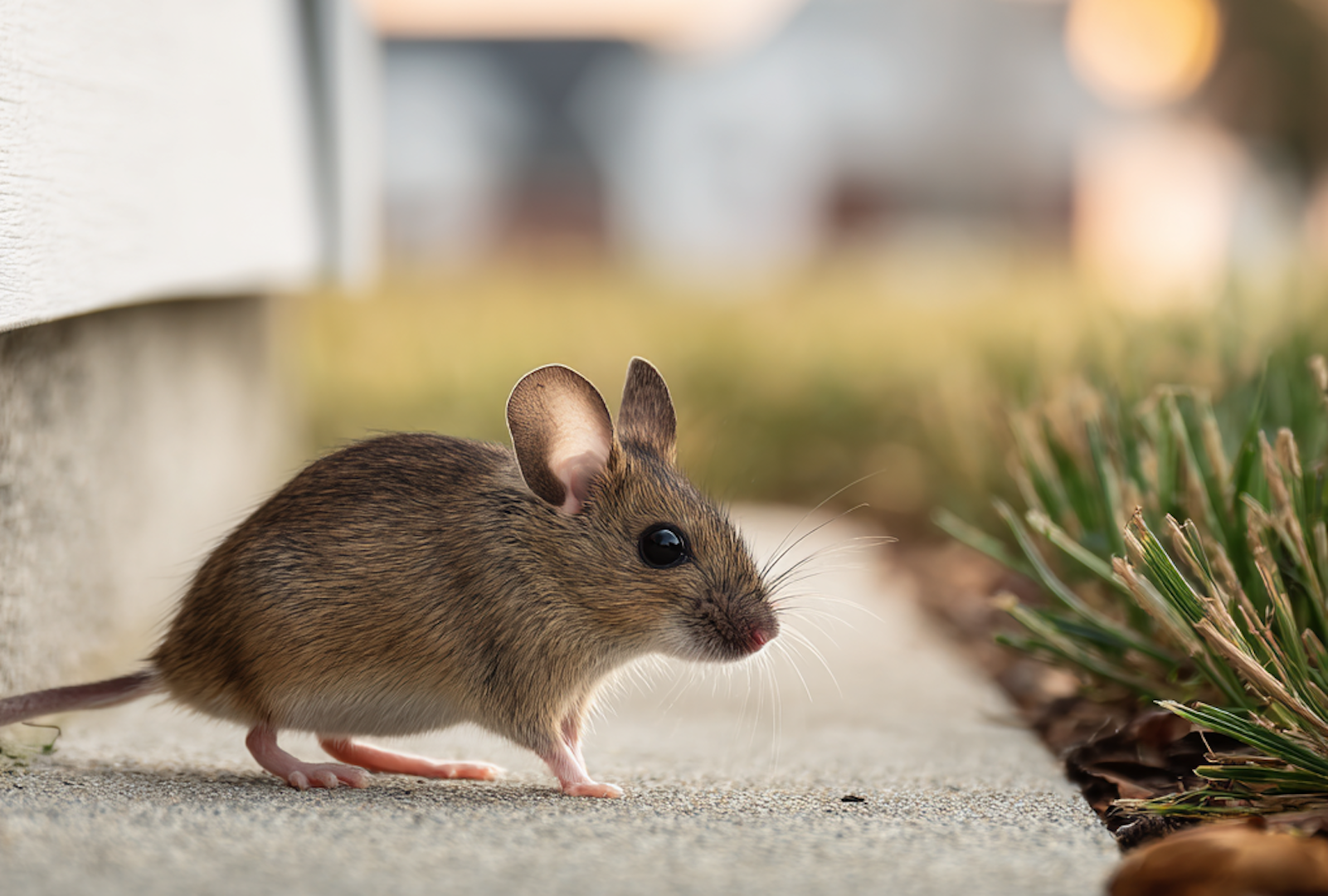
How Do You Know When All the Mice Are Gone in PA and NJ?
Getting rid of mice in Pennsylvania and New Jersey requires careful monitoring and repeated inspections to ensure all the mice are gone.
However, just because mouse activity has paused, it doesn’t mean that mice are gone from your home.
Mice are resilient creatures who can thrive on minimal food sources and avoid being spotted for a long time. Even after store-bought traps stop catching them, your mouse problem may persist silently behind your walls or furniture.
This guide will help you determine when mice have been eradicated from your property and explain why professional rodent control inspections are often necessary to confirm successful eradication.
Why It’s Hard to Confirm Mice Are Completely Gone
Mice are cautious and often adapt their behavior to their environment. Once mouse traps begin to appear and other pest control methods are put into action, they will avoid the locations where the traps and controls are placed.
Rodents are not smart enough to avoid traps altogether, but if you use the same location, they will avoid that area.
Mice are also nocturnal animals that travel through wall voids. Mice entry points can be extremely small, squeezing through holes as small as a dime, and hard to see, making it nearly impossible to inspect their nesting locations and determine where they travel. All of which makes it even more difficult to get a read on their activity.
Types of Mouse Removal Methods
Ensuring all the mice are out of your home starts with the proper pest control methods. Mind you, setting traps, while effective, is only one part of the process. Below are some common mouse removal methods that are effective at getting rid of mice in the northeast:
Snap Traps
Snap traps are among the most effective tools for quickly removing mice. When baited properly with peanut butter, they attract mice visually and through smell. However, there’s no guarantee that they will completely eliminate a mouse infestation.
Glue Traps
Glue traps capture mice that avoid snap traps but are best used as monitoring tools. They don’t instantly kill mice and are often viewed as inhumane. They’re also only generally effective for a single capture.
Bait Stations
Bait stations are great for dealing with mice that avoid traps. However, they take time to work, and dead mice may remain in wall voids and other inaccessible areas.
Exclusion and Sealing
Sealing entry points prevents new mice from entering and traps existing mice within. Follow-up monitoring and trap use are important to ensuring the current mouse population is dealt with.
How Long Does it Take to Eliminate Mice Entirely?
Eliminating mouse problems can take anywhere from 2 to 4 weeks. The severity of the problem, the size of the home, and other factors directly contribute to the time it will take.
Results depend on how quickly mice lose access to food sources, how many nesting areas there are, and whether or not all potential mouse entry points have been properly sealed.
Signs Mouse Activity Has Stopped
The key to determining if mice are no longer present is a consistent absence of activity. The following clues can alert you that mouse activity has ceased altogether:
- No new mouse droppings for ten to 14 days
- Traps remain untouched
- No scratching or movement sounds at night
- No new gnaw marks or food damage
- Odors slowly fade rather than worsen
It will be impossible to confirm if a mouse infestation is gone without a proper rodent inspection.
Preventing Reinfestation After Mice Are Gone
Homeowners should take the following steps to keep new mice from entering their home:
- Seal gaps, cracks, and structural entry points
- Store food in airtight containers
- Remove clutter and nesting materials
- Clean areas where droppings were found
- Reduce exterior attractants near foundations
Exclusion is always the best way to prevent mice from entering homes.
Why Quarterly Pest Inspections Are Important for Stopping Mice
Getting mice out of your home is incredibly important because they spread disease, contaminate food sources, and can even cause serious damage to your property. A quarterly pest protection plan will ensure you keep mice out for good during any season.
A home protection plan involves ongoing monitoring and pest prevention techniques, such as exclusion.
Homeowners can do it themselves with proper supplies and research, but working with a professional yields the best results. Your local exterminator can set you up with a personalized strategy and schedule routine inspections to keep mouse infestations from getting out of hand or even starting in the first place.
FAQs
If I don’t see mice, does that mean they’re gone?
No. Mice are expert hiders and can survive on minimal supplies. You’ll need to keep an eye out for consistent inactivity to ensure they are no longer present.
Should traps stay out after mice disappear?
Yes, traps should be left out for two weeks after activity stops to ensure no mice remain.
How long should I wait without droppings before feeling confident?
If no new droppings or other signs of activity reveal themselves after ten to 14 days, you’re in the clear.
Can mice leave on their own without treatment?
Not typically. Once mice establish themselves, they aren’t likely to voluntarily move on.
Why do I still smell odors after mice are gone?
Urine, droppings, and nesting materials may continue to create odors even after mice are gone.
Can one remaining mouse restart an infestation?
A pregnant female can restart an infestation, even if all others have been eliminated.
How do professionals confirm mice are eliminated?
Professionals monitor traps, track activity, and seek out nesting sites to determine the status of an infestation.
Should I keep bait stations after mice are gone?
In higher-risk homes and for severe infestations, bait stations can be very useful for dealing with mice that have learned to avoid traps.
How do I prevent mice from coming back?
Eliminate food sources, seal entry points, and keep your house clean and clutter-free. A professional pest control specialist can also conduct routine inspections to ensure no new mice have appeared.
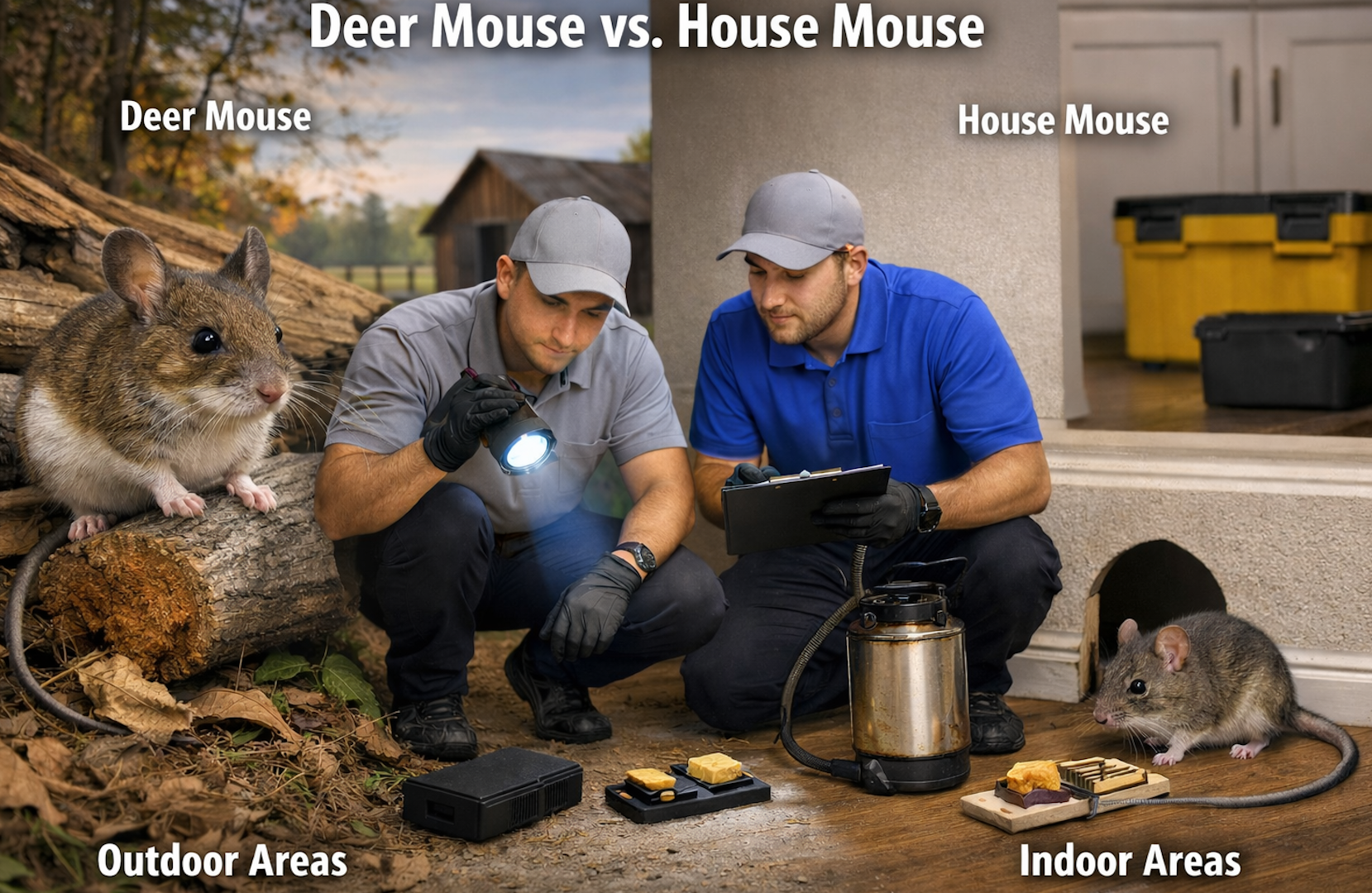
What’s the Difference Between Deer and House Mice in PA?
Deer mice and house mice are the two most common types of rodents found throughout New Jersey and Pennsylvania.
While both small rodents, these two mice behave very differently, carry different health risks, and require slightly different pest control strategies.
Proper identification of house mice and deer mice provides valuable insight into potential health risks and how to properly eliminate them from where they nest most.
Learn how our expert technicians properly identify different mouse species in the northeast and the tools we use to eliminate infestations before they spread.
Deer Mice vs. House Mice: Which Is More Common?
House mice are the most common mice found inside homes across Pennsylvania and New Jersey. They thrive in residential and commercial buildings because these structures provide consistent warmth, food sources, and protection from predators.
House mice are frequently found in basements, crawl spaces, attics, wall voids, and attached garages, especially during fall and winter.
Deer mice are far more common outdoors in Pennsylvania and New Jersey. They live in wooded areas, fields, barns, sheds, and rural properties where natural cover is abundant.
In these states, deer mice are often confused with field mice, another outdoor species with similar behavior and habitats.
Deer mice prefer outdoor environments and rarely establish full indoor infestations. They typically enter structures only when temperatures drop or when buildings sit close to forests or farmland, such as cabins, pole barns, or homes near wooded lots.
How to Distinguish Between Deer Mice and House Mice
Deer mice and house mice look similar at first glance, which often leads to misidentification. Correct identification matters because each species behaves differently and requires a different control approach. You can tell them apart by focusing on physical traits, habitat clues, and where activity is occurring.
Coloration and Size Differences
Deer mice have more visible contrast in their appearance. Their fur is usually brown or tan on top with a clearly white or light gray belly. Their tails are bi-colored, dark on top and lighter underneath. They also have noticeably larger eyes and ears, which help them survive outdoors in Pennsylvania and New Jersey’s wooded and rural areas.
House mice tend to have a more uniform look. Their fur is gray or brown with little contrast between the back and belly. Their tails are long, thin, and mostly hairless with consistent coloring. Their eyes and ears are smaller compared to those of deer mice.
Habitat and Nesting Preferences
Deer mice are most commonly found in areas that provide access to the outdoors, including:
- Fields
- Woodpiles
- Crawlspaces
- Sheds and barns
It should be noted that, even when nesting indoors, deer mice will use outdoor materials, like leaves and grass, to build nests.
House mice are most commonly found indoors, nesting in the following areas:
- Wall voids
- Cabinets
- Attics
- Behind appliances
While house mice will nest anywhere, they prefer to be near food stores, trash, and warmth.
Indoor vs. Outdoor Behavior
One of the biggest differences between house mice and deer mice is their preferences for dwelling areas. House mice thrive indoors, while deer mice prefer the outdoors.
Both will actively avoid humans, and if you do see them, it’s often an indication that you’re dealing with a growing infestation.
Diet and Feeding Habits
Both species are omnivores, but the specifics of their diets vary. Deer mice typically eat insects, seeds, berries, and grains. House mice target human and pet food, as well as any grains or seeds in a home.
Deer Mice vs. House Mice: Table
| Category | Deer Mice (PA & NJ) | House Mice (PA & NJ) |
| Dwelling areas | More common outdoors | Most common indoor mouse |
| Primary environment | Wooded areas, fields, rural properties | Homes and commercial buildings |
| Likelihood of indoor infestation | Low and usually seasonal | High and often long-term |
| Fur coloration | Brown or tan back with white or light gray belly | Gray or brown with little belly contrast |
| Tail appearance | Bi-colored, dark on top and light underneath | Uniform color, long and mostly hairless |
| Eye and ear size | Larger eyes and ears | Smaller eyes and ears |
| Common nesting locations | Fields, woodpiles, sheds, barns, crawlspaces | Wall voids, attics, cabinets, behind appliances |
Which Mouse Is More Dangerous?
Both deer mice and house mice pose risks to homeowners. However, deer mice are considered more dangerous because of their association with hantavirus pulmonary syndrome. While cases are rare in Pennsylvania, deer mice are the primary carriers.
That’s not to say there are no risks associated with house mice. They are known to spread bacteria and allergens, contaminate food sources, and cause damage to your property.
In any case, spotting mice in your home is a prompt to take immediate action and begin removing them.
Signs Of a Mouse Infestation
While each species differs in terms of behaviour, both leave similar signs indicating their presence. If you suspect there are mice in your home or want to stop infestations early, keep an eye out for the following signs and take immediate action when you see them:
- Droppings
- Gnaw marks on food packaging and insulation
- Shredded nesting materials, like shredded packaging and insulation
- Scratching and rustling noises in walls or ceilings
- Grease marks along baseboards and walls
The key difference in identifying a house mouse vs. a deer mouse will be where these signs take place (i.e., indoors or outdoors).
Are Mouse Traps Effective Against Deer Mice and House Mice?
Yes, mouse traps are very effective for dealing with mice, especially when baited with strong-scented, appealing food like peanut butter. However, proper trap placement is very important to their success.
You should place them near travel routes, nesting areas, and food sources to ensure they work.
It’s important to note that traps are just one piece of the puzzle. Sealing entry points, removing clutter, and properly storing food and trash are just as important for eliminating mice from your home.
When to Call a Professional for Mouse Identification
Regardless of the species of mouse you find in your home, contacting a pest control professional is often the smartest next step. Proper identification is important because deer mice and house mice behave differently, pose different risks, and require different control strategies. A professional can confirm the species based on physical signs, nesting materials, droppings, and activity patterns, which can be easy to misinterpret without experience.
Calling a specialist also helps prevent minor problems from becoming larger infestations. Mice reproduce quickly, and visible activity often indicates that more are hidden in wall voids, attics, or crawl spaces. Pest control professionals assess entry points, food sources, and nesting areas to determine how mice are getting inside and why they are staying.
Even if you plan to handle trapping or removal yourself, a professional mouse inspection can reduce guesswork. Specialists provide guidance on exclusion, sanitation, and long-term prevention so the issue does not return with seasonal changes or colder weather.
FAQs
Are deer mice commonly found in Pennsylvania homes?
Yes, but they primarily live outdoors in wooded areas. However, they occasionally make their way into homes.
How can I tell if I have deer mice or house mice?
Deer mice have larger eyes and ears than house mice. They also have white or grey bellies with brown or tan fur on their backs.
Do deer mice infest homes like house mice do?
No. Deer mice don’t generally infest homes to the scale of house mice, as they prefer to be outdoors.
Are droppings different between deer mice and house mice?
They’re very similar. Location and behavior patterns are better indicators than droppings alone.
Can deer mice carry hantavirus in Pennsylvania?
Cases are rare, but deer mice are the primary carriers of hantavirus in Pennsylvania.
Do both types of mice require the same control methods?
Yes. The only difference is that safe handling of deer mice is especially important because of the health risks.
Where do deer mice usually nest compared to house mice?
House mice tend to nest well within the home near sources of warmth, while deer mice prefer outdoor transitional areas that place them closer to their preferred habitat.