
DIY works for one job and one job only: removing the standing water where mosquitoes breed. That part is free; it is the most important step, and no professional service replaces it.
Everything else sold to homeowners for mosquito control (citronella candles, foggers, zappers, hose-end sprays) delivers hours of relief at best. Professional barrier treatment is what holds a Wilkes-Barre yard for weeks at a time.
So the practical answer for most homeowners is both: dump the water yourself, then use a monthly mosquito and tick barrier treatment to handle the adults flying in from everywhere you cannot control. This guide shows the cost and effectiveness of each option so you can decide where your money actually goes.
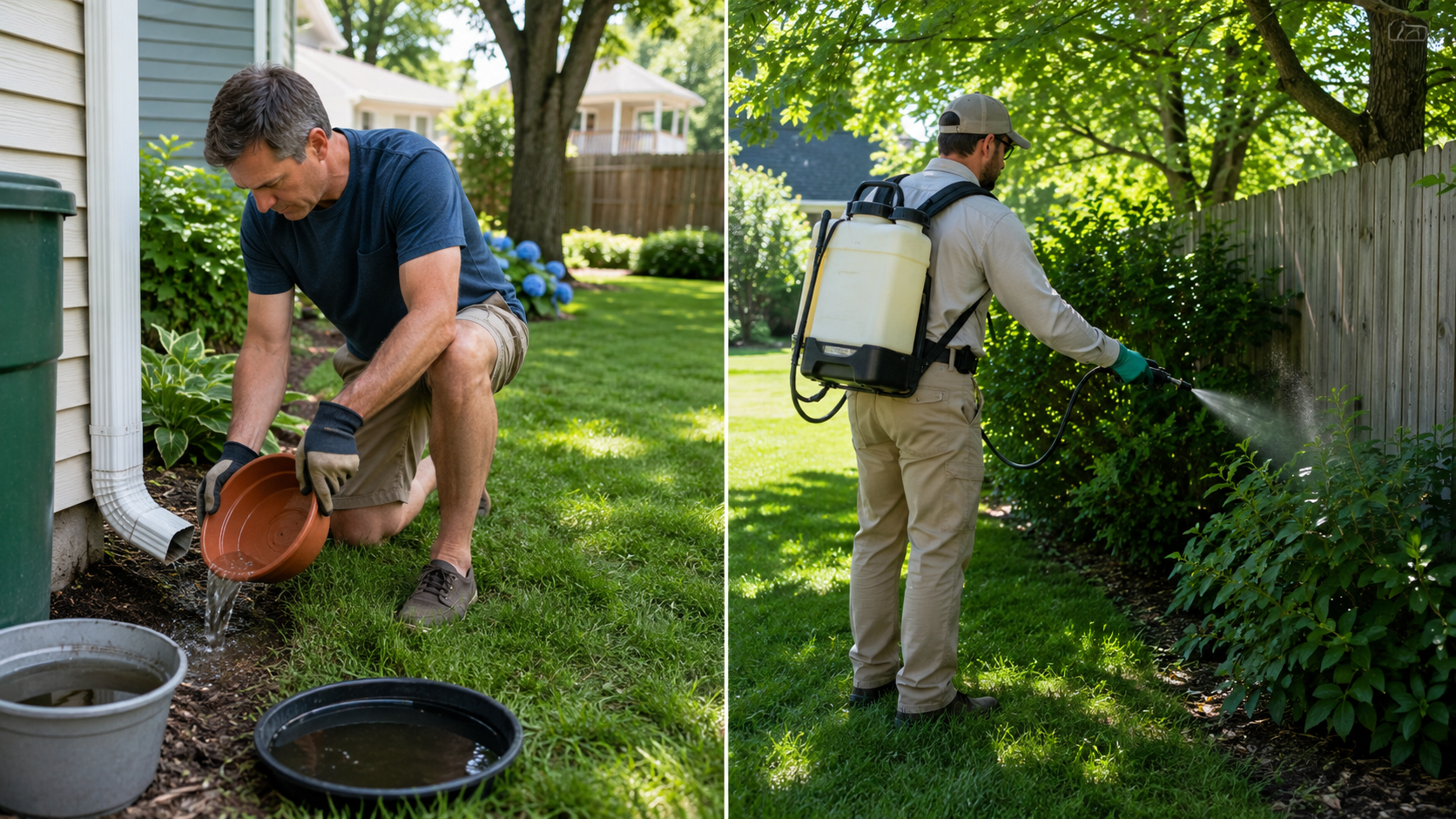
Which Works Better for Wilkes-Barre Mosquitoes: DIY or a Pro?
Split the problem in two, and the answer becomes obvious.
DIY wins. Walking your yard and emptying every container that holds water is the highest-value mosquito control action available, and it costs nothing. A professional will recommend the exact same thing.
Professional treatment wins clearly. Adults resting in your shrub line, fence row, and shaded beds are not affected by anything you dump out, and consumer products do not leave enough residual on foliage to matter.
Much of the mosquito pressure here originates off your property. Floodplain low ground along the Susquehanna corridor, storm drains, neighboring lots, and wooded edges all produce mosquitoes that fly to you. You cannot dump someone else’s water.
Why Do Citronella, Foggers, and Store Sprays Fail?
Each one fails for a specific, understandable reason. Knowing the reason keeps you from spending the same money twice.
Citronella candles: Citronella masks the carbon dioxide and body odors mosquitoes use to find you, but the effect is weak, and it drops off fast with distance and wind. A University of Guelph field study of 3 percent citronella candles and 5 percent citronella incense found them ineffective at reducing mosquito annoyance under real outdoor conditions. A separate indoor trial measured a repellency rate of about 29 percent for 5 percent citronella candles. A candle may help slightly at the table you are sitting at. It does nothing for a yard.
Foggers and propane traps: Foggers knock down the adults flying at the moment you spray, then leave almost no residual behind. Protection is generally measured in days, not weeks, and mosquitoes from surrounding property move back in almost immediately.
Hose-end and aerosol yard sprays: Consumer formulations are diluted for untrained use and lack the adhesion chemistry that makes professional products bond to leaf surfaces. They also tend to disperse into the air rather than coating the underside of foliage where mosquitoes actually rest.
Bug zappers: Zappers attract insects with UV light, but mosquitoes are drawn to carbon dioxide and body heat instead. Research has repeatedly shown mosquitoes make up a tiny share of what zappers kill, while beneficial insects make up most of it.
One product that does work: larvicide dunks containing Bti, a naturally occurring bacterium, are available to homeowners and are effective in water you cannot drain, such as a rain barrel or an ornamental pond. Penn State Extension includes them in its integrated pest management guidance for mosquitoes.
Barrier Spray vs. Misting System vs. Larvicide: What Is the Difference?
Three professional approaches, three different jobs. Most Wilkes-Barre properties need the first, sometimes combined with the third.
A technician applies a residual product to the vegetation, fence lines, and shaded perimeter areas where adult mosquitoes rest during the day. It kills on contact and keeps working as mosquitoes land on treated surfaces. Industry-standard residual is roughly 21 to 30 days, which is why service runs monthly through the season.
Applied directly to water that cannot be drained, it stops larvae from becoming biting adults. It does not touch adults already flying, so it complements barrier treatment rather than replacing it.
A permanent installation of nozzles around a property that releases insecticide on a timer. Installation typically runs $1,200 to $2,500 plus $400 to $700 per year in maintenance. It delivers convenience at a high cost, and because it sprays on a schedule rather than on inspection, it uses far more product over a season.
For nearly every residential property in the Wyoming Valley, monthly barrier treatment with targeted larvicide where needed gives the best result per dollar.
DIY vs. Professional Mosquito Control: Cost and Effectiveness
Costs below reflect typical 2026 pricing. Professional yard treatment in Northeast Pennsylvania is quoted after a property assessment, because lot size, tree cover, and water sources drive the price.
| Method | Typical Cost | How Long It Lasts | What It Actually Does |
|---|---|---|---|
| Dumping standing water (DIY) | $0 | Ongoing, if repeated weekly | The most effective single action available. Removes the breeding source on your own property. |
| Citronella candles | $5 to $25 each | While burning, a few feet | Weak masking effect at close range. Field testing found no meaningful reduction in outdoor annoyance. |
| Bug zapper | $30 to $150 | Not effective | Kills mostly non-target insects. Mosquitoes are a small fraction of the catch. |
| Store-bought fogger or hose-end spray | $15 to $60 per round | Hours to a few days | Knocks down adults present at application. Minimal residual, rapid reinfestation. |
| Bti larvicide dunks (DIY) | $10 to $30 | About 30 days per dunk | Genuinely effective in standing water you cannot drain. Does not affect flying adults. |
| Professional barrier treatment | Quoted per property; monthly seasonal plans are the common structure | About 21 to 30 days per application | Treats adult resting sites across the yard, covers ticks in the same visit, and includes inspection for breeding sources. |
| Misting system | $1,200 to $2,500 install, plus $400 to $700 per year | Continuous, on a timer | Convenient but expensive, and applies product on a schedule rather than based on inspection. |
Note on one-and-done treatments: a single barrier application will noticeably reduce mosquito pressure for about three to four weeks, then fade as sunlight, heat, and rain break the product down.
Mosquitoes never stopped breeding during that window, so one treatment in June does not carry a yard through August. That is the entire reason barrier service is structured monthly instead of annually. Our guide to mosquito and tick barrier spray covers the re-treatment cadence in more detail.
What Does a Professional Mosquito Treatment Include?
A legitimate service is more than someone walking the perimeter with a sprayer. Here is the sequence.
- Property inspection: The technician identifies breeding sources (gutters, containers, low spots, tarps) and maps the shaded resting areas where adults spend the day.
- Source reduction guidance: You get a specific list of what to drain or fix on your property. This is the part that keeps the treatment working.
- Targeted barrier application: Product is applied to the underside of foliage, shrub lines, fence rows, and shaded perimeter zones using a backpack mist blower rather than a broadcast spray. This follows integrated pest management principles, which prioritize targeted application over blanket spraying.
- Larvicide where needed: Applied to standing water that cannot be drained.
- Tick coverage in the same visit: Barrier treatments target the same lawn edges, landscape beds, and shaded zones where blacklegged ticks wait. In Pennsylvania, where Lyme disease is a persistent concern, this is a real part of the value.
- Scheduled re-treatment: Monthly service through the season refreshes the barrier before it fully degrades. The Pest Rangers applies monthly barrier sprays across Northeast Pennsylvania, with noticeable relief typically within 24 hours of the first application.
When Should You Call a Pro?
Stay DIY when:
- You found a clear container source and clearing it solved the problem
- Bites are occasional and limited to dusk
- You are willing to walk the yard weekly during the season
- Your lot is open, sunny, and has no adjacent woods or wet ground
Call a professional when:
- Pressure stays high after you have removed every water source you can find
- Your property borders woods, a creek, a drainage ditch, or floodplain low ground
- You are being bitten during the day, which points to established container breeding
- You have an event on a specific date and need reliable results
- Ticks are also present, since one treatment covers both
- Someone in the household is older, immunocompromised, or reacts badly to bites
If you are still trying to work out why your yard is so bad in the first place, start with why you have so many mosquitoes in your Wilkes-Barre yard.
FAQs
How long does a professional mosquito treatment last?
A barrier application typically holds for about 21 to 30 days. Protection is strongest in the first two weeks, then the active ingredient degrades from UV exposure, heat, and rain.
Heavy rainfall right after application can shorten it, which is why service is scheduled monthly through the season rather than as a one-time job.
Will one treatment fix my mosquito problem for the summer?
No, and any company that promises that is overselling. One treatment gives you three to four good weeks. Mosquitoes continue breeding in surrounding areas the entire time, so consistent monthly service through the season is what actually keeps pressure down.
Is professional mosquito treatment safe around kids and pets?
Products are EPA-registered and applied by technicians licensed through the Pennsylvania Department of Agriculture. The standard guidance is to stay off the treated area while the product is wet, which is usually about 30 minutes, and to return once it has dried.
Tell your technician in advance about pets, pollinator gardens, vegetable beds, or anyone in the home with sensitivities so the application can be adjusted.
Does mosquito spray kill bees?
It can if applied carelessly, which is why application method matters. A trained technician treats shaded resting vegetation rather than flowering plants, and times applications to avoid peak pollinator activity. If you keep a pollinator garden or hives, point them out before the first treatment.
Can I do DIY and professional treatment together?
Yes, and that combination gives the best result. You handle source reduction weekly, the professional handles the adult population and the sources you cannot reach. Let your technician know what products you have already applied so the plan accounts for it.
How much does mosquito control cost in Wilkes-Barre?
Seasonal mosquito and tick programs are quoted after a property assessment, because lot size, tree cover, standing water, and how much of the yard needs coverage all move the price. Ask for pricing on both a single treatment and a full-season plan so you can compare the per-visit cost.