
You have so many mosquitoes because something on or near your property is holding water long enough for them to breed. In Wilkes-Barre, three things stack on top of each other: standing water in yard containers, the humid summer air of the Wyoming Valley, and the Susquehanna River floodplain that surrounds the city.
Mosquitoes only need water that sits for about four days to complete a generation. That means a clogged gutter, a forgotten bucket, or a sagging tarp can produce hundreds of biting adults without you ever noticing the source.
Below you will find where they breed, which species bite here, what the real health risk is in Luzerne County, and when a yard problem needs professional mosquito and tick treatment.
What Are the Top Reasons Mosquitoes Swarm Wilkes-Barre Yards?
Four local conditions drive almost every mosquito call we get in the city. Each one works the same way: it gives females a place to lay eggs and gives adults a cool, shaded place to rest during the day.
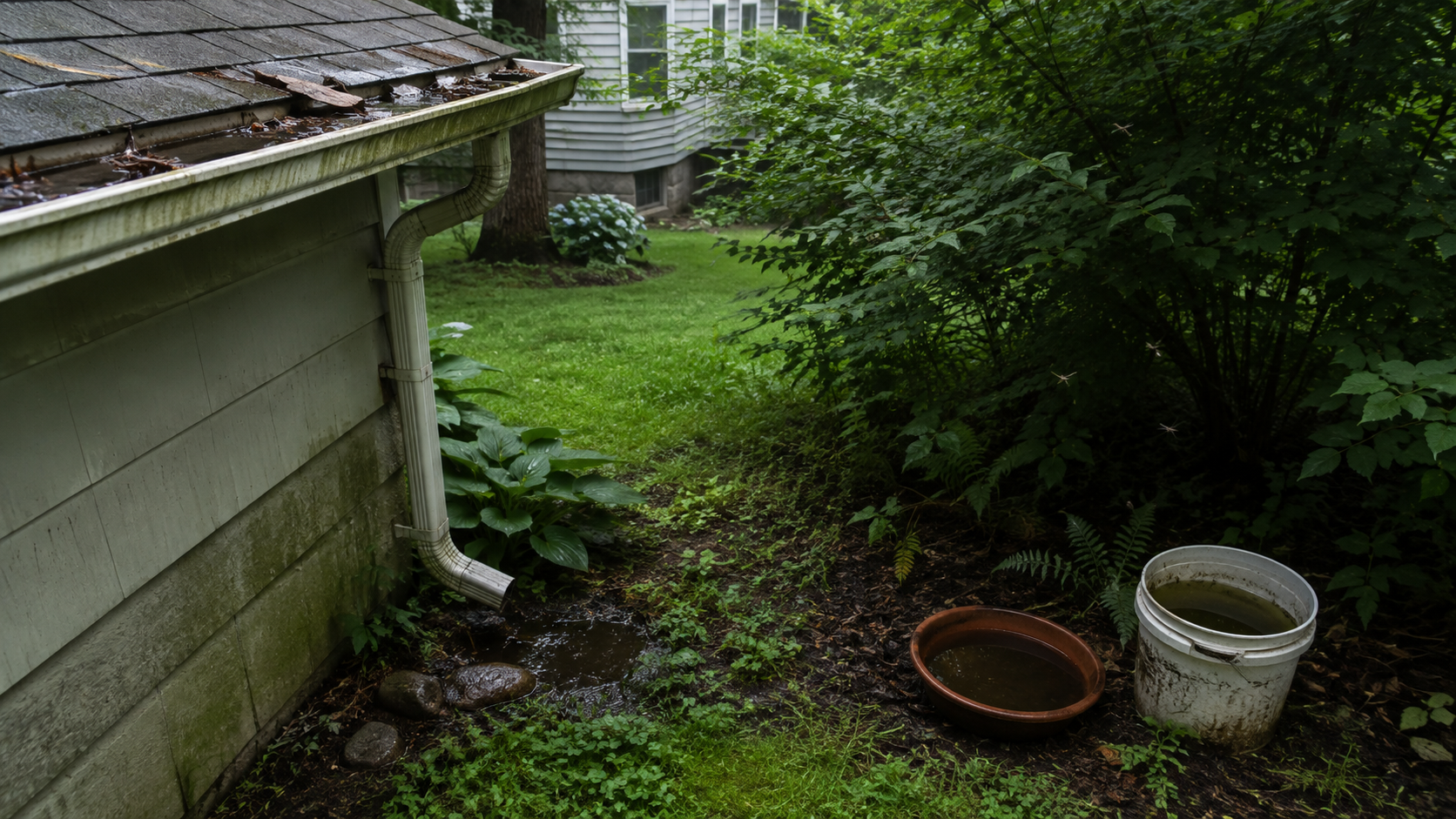
Standing water you have not noticed: Mosquitoes will breed in any still water that stands for more than four days. Most of it is not a pond. It is a saucer under a flowerpot, a kid’s pool, a tire, or a gutter that has not drained since spring.
Wyoming Valley humidity: Warm, humid air keeps adult mosquitoes alive longer and speeds up the time it takes eggs to become biting adults. Some species can finish the cycle in as little as seven days, though Penn State Extension notes 10 to 14 days is more typical in Pennsylvania.
The Susquehanna floodplain: Wilkes-Barre sits behind a levee system on a valley floor that stays damp. Floodplain mosquitoes lay eggs in leaf litter and soil, and those eggs hatch when the low spots fill with water after a heavy rain. Luzerne County’s mosquito program has specifically flagged the county’s floodplain topography as a driver of local mosquito problems.
Dense shade and overgrowth: Mosquitoes do not fly all day. They rest in cool, shaded vegetation and only come out to feed. Thick shrub lines, ivy, tall grass along a fence, and the shaded north side of a house give them somewhere to wait out the heat.
Technician note: The single most common source we find on Wilkes-Barre properties is not a pond or a creek. It is a clogged gutter. Older homes in the Heights, North End, and South Wilkes-Barre often have original gutter runs that hold a shallow line of water and leaf sludge all summer.
Where Do Mosquitoes Breed Around Your Home?
Almost every backyard breeding site falls into one of five categories. Walk your property once with this list and you will usually find the source in under 15 minutes.
Breeding-site checklist:
- Clogged gutters and downspouts: the most common source on older Wilkes-Barre homes. Water pools behind leaf packs and never drains.
- Containers: flowerpot saucers, buckets, watering cans, recycling bins, wheelbarrows, birdbaths, pet bowls, and discarded tires.
- Tarps and covers: grill covers, pool covers, woodpile tarps, and boat covers that sag and hold a pocket of rainwater.
- Shaded low spots: ruts in the lawn, low corners of the yard, window wells, and areas where downspouts dump onto flat ground.
- Neglected water features: unmaintained swimming pools, ornamental ponds without circulation, rain barrels without screens, and clogged storm drains along the curb.
Two notes that save people time. First, moving water is generally not the problem, so a creek or a properly circulating pond is much less likely to be your source than a still bucket. Second, you do not need much water. A bottle cap holds enough for a mosquito to reproduce.
Which Mosquitoes Bite in Luzerne County?
Pennsylvania has more than 60 mosquito species, but only some bite people. According to Penn State Extension, the most common species around Pennsylvania homes are the northern house mosquito and the Asian tiger mosquito.
Northern house mosquito (Culex pipiens): Small to medium, brown, with no bold markings. It is the most common mosquito in Pennsylvania and the primary carrier of West Nile virus in the state. It feeds mostly at dusk and dawn and breeds readily in containers and stagnant water around homes.
Asian tiger mosquito (Aedes albopictus): Easy to spot, with bold black and white stripes on its legs and body. Unlike most mosquitoes, it bites aggressively during the day. It is an invasive species that has expanded its range north through much of Pennsylvania since 2001, and it is a determined container breeder.
Floodplain species: These lay eggs in leaf litter and damp soil rather than in open water, then hatch in large numbers when woodland pools and floodplains fill after rain. They matter more here than in most of the state because of the Susquehanna corridor running through the Wyoming Valley.
Why this matters for you: a daytime biter points toward a container source close to the house, while a dusk-only biter points toward stagnant water nearby. Knowing which one is biting helps narrow the search.
What Is the Health Risk From Mosquitoes in Pennsylvania?
The honest answer: the risk for any one person is low, but it is not zero, and it is monitored closely in Luzerne County for a reason.
West Nile virus is the realistic concern. The Pennsylvania Department of Environmental Protection reports that roughly 1 in 150 people infected with West Nile develop a severe form of the illness, and there is no specific treatment or vaccine. Most people who are infected recover fully, and many never show symptoms at all.
Eastern equine encephalitis (EEE) is rare but serious. The Pennsylvania Department of Health reports only two human EEE cases in the state since 1964. When it does occur, roughly 30 percent of cases are fatal and many survivors have lasting neurological effects. Risk is highest from late July through September.
Local surveillance is active every season. The Luzerne Conservation District administers the county’s Mosquito-borne Disease Control Program and collects adult and larval samples at least twice a week from April through October. State crews set roughly 30 traps in and around the county each year, and West Nile has been detected here every year since trapping began in 2001.
Practical takeaway: you do not need to panic about a few bites. You do need to take standing water seriously, especially from late July through September when virus activity peaks.
What Are the Signs You Have a Breeding Site on Your Property?
Mosquitoes that fly in from a neighboring lot behave differently than mosquitoes breeding in your own yard. These four signs point to an on-site source.
- Bites happen in one specific area. If the back corner near the shed is unbearable but the front yard is fine, the source is almost certainly within a short distance of that corner.
- You see wigglers in standing water. Mosquito larvae look like small comma-shaped threads that jerk toward the bottom when disturbed. Check any container holding water. If you see them, you have found a source.
- Activity spikes three to seven days after rain. A predictable surge a few days after every storm means water is collecting somewhere and producing a new batch.
- Mosquitoes rise when you disturb shrubs. If brushing past a hedge or mowing near a tree line sends up a cloud, that vegetation is a resting site and a breeding source is likely close by.
When Is DIY Mosquito Control Not Enough?
Dumping standing water is the single most effective thing a homeowner can do, and it is free. Start there every time. But source reduction has limits.
DIY is usually enough when:
- You found an obvious container source and emptied it
- Bites are limited to one small area of the yard
- Activity drops noticeably within a week of clearing the water
You need professional help when:
- Mosquito pressure stays high after you have cleared every container you can find
- The source is off your property (a neighbor’s pool, a drainage ditch, a wooded lot)
- Your yard backs up to woods, a creek, or floodplain low ground
- You are hosting an event and need reliable relief on a specific date
- Ticks are also a problem, since barrier treatments cover both
FAQs
How far do mosquitoes travel from where they breed?
It depends on the species. Container breeders like the Asian tiger mosquito usually stay within a few hundred feet of where they hatched, which is why a daytime biting problem almost always traces back to your own yard or your immediate neighbor’s. Floodplain species can travel considerably farther.
Why do I have mosquitoes when I do not have standing water?
You almost certainly have water somewhere you have not checked. The usual culprits are clogged gutters, a sagging tarp, a corrugated downspout extension, a window well, or a low spot that holds water for a few days after rain. Floodplain species can also fly in from wet ground nearby.
When is mosquito season in Wilkes-Barre?
Mosquito season in Pennsylvania generally runs April through October, which is also when Luzerne County conducts its surveillance trapping. Activity typically peaks in July and August, and West Nile detections tend to climb in late summer.
Do mosquito-repelling plants work?
Not meaningfully on their own. Plants like citronella grass and lavender contain compounds that repel mosquitoes when the oils are extracted and concentrated, but a living plant sitting in a pot does not release enough to protect a yard. They are fine as landscaping, not as a control method.
Does a bug zapper reduce mosquitoes?
No. Bug zappers kill large numbers of insects, but studies have consistently shown that mosquitoes make up a very small fraction of the catch, and most of what they kill is harmless or beneficial. They do not reduce biting pressure in a yard.
More answers are on our mosquito FAQ page, and you can see full service details for the area on our Wilkes-Barre pest control page.