
Professional treatment has a significantly higher success rate with carpenter ants because the parent colony is often outside the home and hard to locate.
DIY can work for very isolated, early-stage activity with a single visible trail, but it usually fails when satellite nests are already established inside walls.
For most Poconos homeowners, the honest answer is a mix: try DIY if the problem is small and caught early, and call a professional when you see frass, swarmers, or activity in more than one room.
This guide gives you the trade-offs on cost, timeline, and success rate so you can make the call for your home.
If you are not sure which pest you are dealing with first, the pest identification library can help you confirm the species, and pest control in the Poconos is available in Stroudsburg, Mount Pocono, East Stroudsburg, Tobyhanna, and Lake Harmony, to name a few, if you decide to skip the DIY route.
Which Is Better for Carpenter Ants: DIY or a Professional?
The short version: DIY handles surface-level ant activity. Professional treatment handles the colony. Those are two different problems, and carpenter ants create the second one more often than the first.
DIY works best when: you catch a small trail early, the activity is limited to one room, and there is no frass or signs of nesting inside the structure.
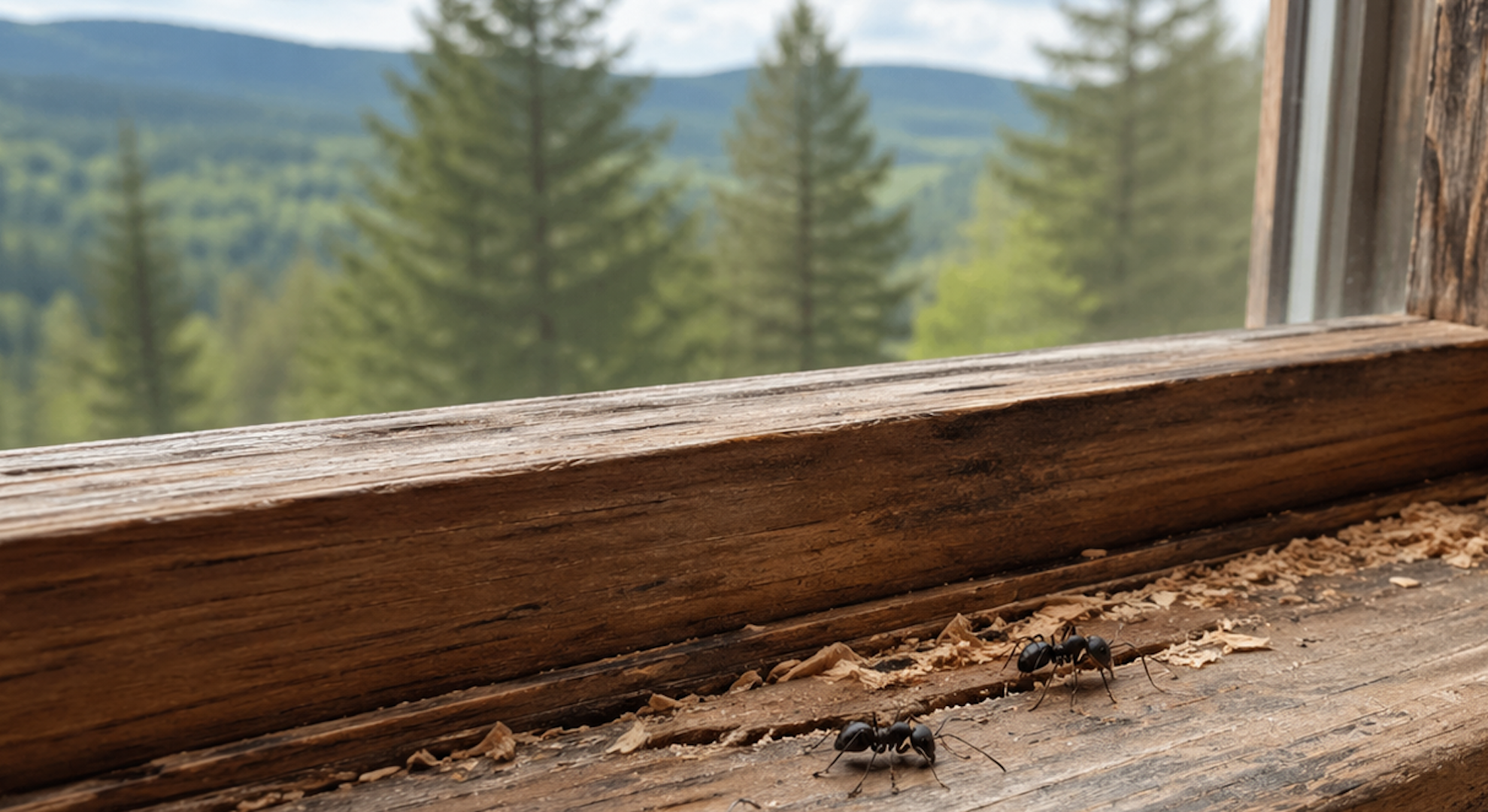
Professional treatment is the better choice when: you see winged swarmers indoors, find sawdust-like frass, hear rustling in walls, or see ants in multiple parts of the home. These signs mean a satellite nest is already inside the structure, and the parent colony is probably somewhere in the surrounding woods.
Carpenter ant colonies often take three to six years to mature, so by the time you see a lot of foragers, the problem has been developing for a while. That history is what makes DIY inconsistent and professional treatment more reliable.
What Does DIY Carpenter Ant Treatment Involve?
DIY carpenter ant treatment usually means buying bait stations, sprays, or dusts at a hardware store and applying them yourself. The approach can work on small, isolated problems, but it requires patience and careful product selection.
Common DIY Methods and Products
- Ant baits: Granular or gel baits containing active ingredients like abamectin, fipronil, or boric acid. Foraging ants carry the bait back to the colony, where it kills the queen and workers over several weeks.
- Contact sprays: Aerosol or liquid sprays containing pyrethroids like cyfluthrin, deltamethrin, or permethrin. These kill ants on contact but rarely reach the nest.
- Dusts: Insecticide powders applied into wall voids or cracks where ants are active. Effective only if you can get the dust close to the nest.
- Natural options: Diatomaceous earth, borax sugar baits, or essential oil sprays. These work in limited cases and usually only against foragers, not the colony.
Before you apply any product, read the label carefully. Using a pesticide in a way that does not match the label is a violation of federal law. The EPA guidance on carpenter ant control spells out the legal use patterns for home pesticide products.
Typical DIY Cost
DIY carpenter ant supplies usually cost $30 to $100 for a full round of treatment.
- Bait stations or gel: $10 to $40
- Contact spray: $10 to $30
- Insecticide dust: $15 to $30
- Duster or applicator tool: $10 to $20
- Protective gloves and eye protection: $10 to $20
The up-front cost is low. The hidden cost shows up later if the treatment fails and the colony keeps expanding, because structural repairs start at a few hundred dollars and can run into the thousands.
Where DIY Usually Fails
DIY fails for predictable reasons. Understanding them helps you judge whether your situation is likely to respond to a store-bought product or not.
- The parent nest is usually outdoors. Most Poconos carpenter ant colonies have a parent nest in a stump, tree, or log within 100 yards of the home. Spraying baseboards does not reach it.
- Satellite nests are hidden. Ants build satellite nests in wall voids, insulation, and roof decking. You cannot bait or spray what you cannot find.
- Contact sprays can make things worse. Repellent sprays can cause a colony to split (a process called budding), creating multiple smaller nests from one original problem. This is a well-documented risk in extension literature on wood-destroying insect control.
- Carpenter ants are picky eaters. Baits only work if the ants accept them. Penn State Extension notes that carpenter ants often ignore baits entirely, which ends the treatment before it starts.
- The strongest products require a license. Non-repellent insecticides that carpenter ants cannot detect (and therefore carry back to the nest) are typically restricted-use products. For more context on colony behavior and why surface sprays often fail, see research on wood-destroying insect control from Rutgers Cooperative Extension.
What Does Professional Carpenter Ant Removal Involve?
Professional carpenter ant removal is a multi-step process built around finding and eliminating the entire colony, not just the ants you see. The goal is colony elimination, not spot treatment.
Inspection and Colony Location
A technician starts with a full inspection of the home and surrounding property. That typically includes:
- Walking the exterior to find stumps, logs, and dead tree limbs that may hold the parent colony
- Checking window frames, door frames, and sill plates for frass
- Inspecting attics, basements, and crawl spaces for satellite activity
- Tracing foraging trails back toward nest sites, usually at dusk or night when carpenter ants are most active
- Identifying moisture problems that support nesting
The inspection often takes longer than the treatment. It is also the step DIY cannot replicate, because finding the parent nest is the hardest and most important part of the job.
Non-Repellent Treatment Methods
Licensed technicians use non-repellent insecticides that carpenter ants cannot detect. Because the ants do not avoid the treated zone, they walk through it, carry the product back to the colony, and transfer it to the queen and the rest of the workers.
Common active ingredients: fipronil, imidacloprid, and similar transferable products used in exterior perimeter treatments. These are the same classes of products state cooperative extension programs identify as most effective for colony elimination.
Application methods: exterior perimeter sprays around the foundation, targeted dust injections into wall voids, and bait placements along foraging trails where appropriate.
Applied during the high foraging season, a single non-repellent perimeter treatment will often control the colony in the structure. For ongoing coverage, many Pocono homeowners choose our Home Protection Plan, which includes carpenter ant coverage along with other common pests.
Moisture and Entry Point Correction
Eliminating the current colony is only half the job. If the conditions that attracted the ants remain, another colony will move in within a year or two. That is why professional treatment almost always includes recommendations for:
- Clearing gutters and directing downspouts away from the foundation
- Repairing leaking pipes, roofs, and flashing
- Removing stumps and firewood from within 100 feet of the home
- Trimming tree branches and shrubs away from siding and rooflines
- Sealing cracks around utility penetrations, windows, and doors
A technician will point out the specific moisture and entry issues on your property. Fixing these is typically on the homeowner, but the guidance saves time and money over multiple service calls.
How Much Does Carpenter Ant Treatment Cost in the Poconos?
Cost varies with home size, infestation severity, and whether the job is one-time or part of ongoing coverage. Published industry data gives reliable ranges for comparison.
DIY treatment: $30 to $100 in products for a single round, sometimes more if multiple products or reapplications are needed.
Professional one-time treatment: typically $150 to $500 nationally, with carpenter ant jobs often landing at $250 to $500 because of the inspection work and targeted products required.
Ongoing protection plans: $40 to $70 per month for quarterly or recurring service that covers carpenter ants along with other common pests.
Structural repair if left untreated: $200 to $2,000 or more, depending on how long the colony was active and which structural elements were affected.
The math usually favors early professional treatment. Spending $250 to $500 once is almost always cheaper than spending that same amount on failed DIY attempts, then paying for professional service, then paying for repairs.
Which Option Has a Higher Success Rate?
Professional treatment has a higher success rate for carpenter ants than DIY. The gap comes down to access to products, access to the nest, and experience identifying satellite colonies.
Side-by-side comparison:
| Factor | DIY Treatment | Professional Treatment |
|---|---|---|
| Average cost | $30 to $100 in products | $250 to $500 per visit, or $40 to $70 per month on a plan |
| Time to resolve | Several weeks if baits work; often never if nest is not located | Noticeable reduction within days; full colony elimination in a few weeks |
| Success rate | Inconsistent; works best only for isolated, early-stage activity | High, especially with a non-repellent perimeter treatment applied during foraging season |
| Colony elimination | Unlikely unless the nest is found and treated directly | Standard goal; most treatments target both parent and satellite nests |
| Products available | Over-the-counter baits, sprays, and dusts | Professional-grade non-repellent insecticides (licensed use only) |
| Warranty | None | Retreatment guarantees common with service plans |
For the official control guidance behind these methods, see Penn State Extension on carpenter ant management. The same guidance informs how licensed technicians approach treatment in Pennsylvania.
When DIY Makes Sense and When It Doesn’t
An honest answer: DIY is not useless. It is just limited. Here is how to decide.
DIY is reasonable when:
- You see fewer than 10 ants over several days, all in one area
- There is no frass, no swarmers, and no rustling in walls
- The trail clearly comes from outside (a cracked door sweep, a window screen)
- You can fix the likely entry point within a few days
- You are willing to monitor for two to three weeks and escalate if activity returns
Call a professional when:
- You find frass piles anywhere in the home
- Winged swarmers appear indoors, especially in spring
- You see ants in multiple rooms or on multiple floors
- Activity continues or worsens after two weeks of DIY treatment
- The home has known moisture damage (old leaks, ice dams, soft window frames)
- You are preparing to sell the home or list it for rental
If you are in the second group, DIY is usually a delay rather than a solution, and the delay lets the colony grow.
What to Ask a Carpenter Ant Exterminator in Stroudsburg or Mount Pocono
Not all pest control companies handle carpenter ants the same way. Ask these questions before signing a contract.
- Are you licensed in Pennsylvania? All technicians should carry a PA Department of Agriculture pesticide applicator license.
- Will you inspect the exterior for parent colonies? A credible answer covers stumps, trees, firewood, and outbuildings within 100 feet of the home.
- What products will you use, and are they non-repellent? Non-repellent products are the industry standard for carpenter ant colony elimination.
- Do you offer a retreatment guarantee? Reputable companies back their work with free retreatment if activity returns within a defined window.
- Will you identify moisture and entry-point issues? Good technicians flag the conditions that attracted the ants in the first place.
- How do you handle seasonal or vacation homes? Lake Harmony, Tobyhanna, and Mount Pocono have a lot of second homes, so a provider who schedules around owner visits is a practical fit.
Carpenter Ant Treatment FAQs
Does carpenter ant spray actually work?
Contact sprays kill the ants they hit, but rarely reach the nest. Repellent sprays can make the problem worse by causing the colony to split into new satellite nests. Non-repellent products are far more effective, and most of the strongest options require a licensed applicator.
When is the best time to treat carpenter ants in the Poconos?
Late spring through early fall is the ideal window because foraging activity peaks in warm weather. Treatments applied during this period get carried back to the colony faster. Winter sightings usually mean a nest is already inside the heated part of the home, and treatment should still happen promptly.
Are professional carpenter ant treatments safe for pets and kids?
Modern products, applied by a licensed technician, are designed for use in and around homes with families and pets. Follow the reentry time on the product label (usually a few hours after application) and store any leftover product out of reach. Always share concerns about specific products with your technician before treatment.
How soon do I need to retreat after professional treatment?
For a one-time non-repellent perimeter treatment, retreatment is often not needed for the season if the job was successful. For properties with heavy wooded surroundings (common in Tobyhanna and Lake Harmony), quarterly service is usually the better long-term approach because new colonies can move in from neighboring woods.
Will one treatment kill the whole colony?
Often, yes, if a non-repellent perimeter treatment is applied during the foraging season and the parent colony is within treatment range. Complete elimination takes several weeks because the product has to spread through the colony before reaching the queen. If activity continues after four weeks, the nest location may need to be reassessed.
Can I combine DIY and professional treatment?
You can, but let the professional know what you have already applied. Prior use of repellent sprays can push ants away from a non-repellent bait, which delays results. Sharing your DIY history makes the professional plan more effective.
For more answers, visit our carpenter ant FAQ.