
Carpenter ant extermination in the Poconos typically costs between $250 and $500 for a one-time treatment in 2026, or $40 to $70 per month on an ongoing protection plan.
The final price depends on home size, infestation severity, and whether you choose a single visit or year-round coverage.
What moves the price up: larger homes, multiple nest locations, signs of structural damage, and hard-to-reach exterior colonies on wooded lots.
What moves it down: early detection, smaller homes, and bundling carpenter ant service into a Home Protection Plan that spreads the cost across the year.
Your pest control in the Poconos team handles carpenter ant calls in Mount Pocono, Stroudsburg, East Stroudsburg, Tannersville, Tobyhanna, and Lake Harmony, and all quotes start with a free inspection.
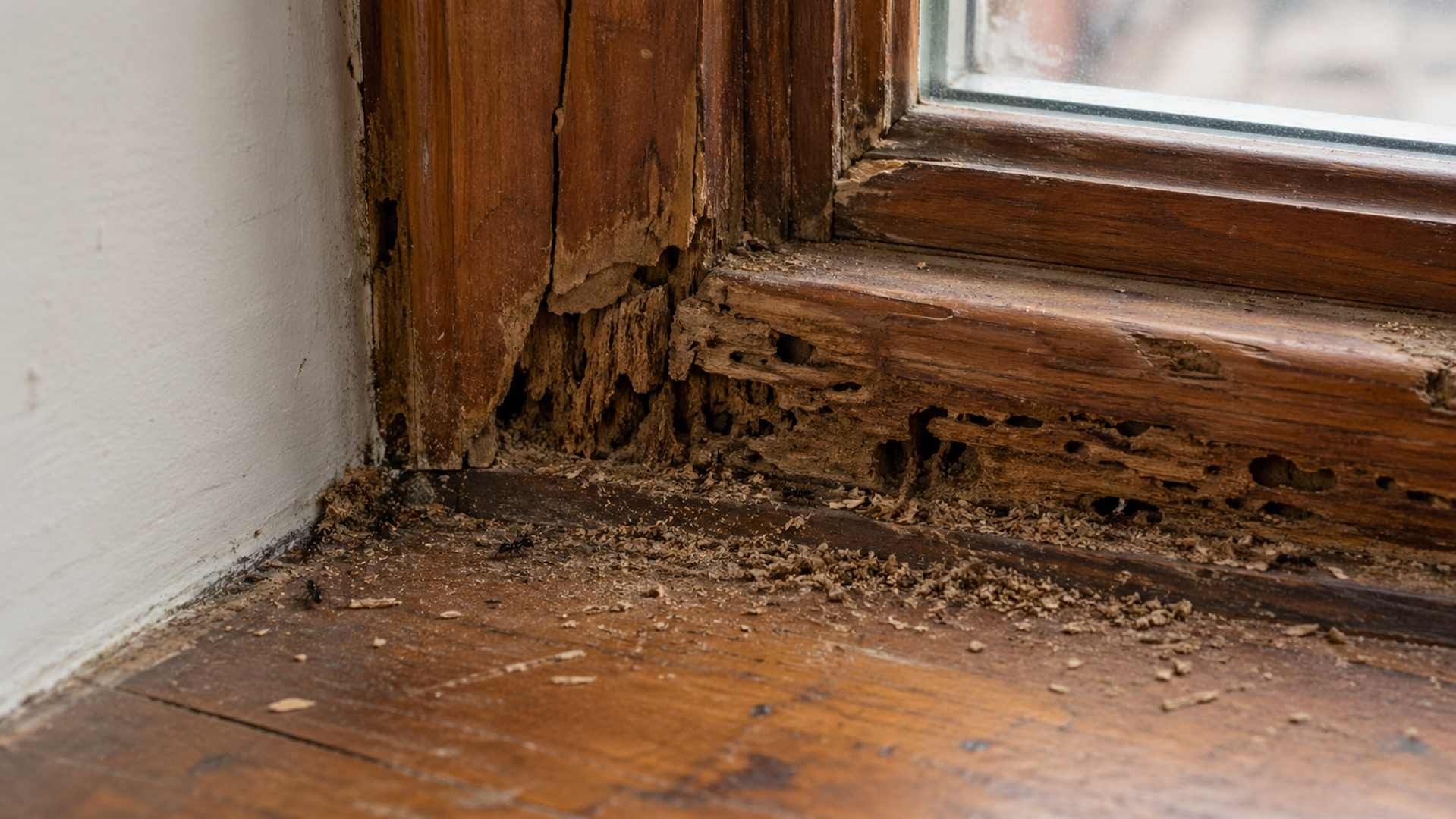
What Does Carpenter Ant Extermination Cost in the Poconos?
Here is the pricing at a glance. These ranges reflect typical 2026 costs for professional treatment in Northeast Pennsylvania, based on industry data for carpenter ant service.
| Service Type | Average Cost | What’s Included | Warranty / Follow-Up |
|---|---|---|---|
| Free inspection | $0 | Full exterior and interior walk-through, nest identification, written quote | No treatment obligation |
| One-time carpenter ant treatment | $250 to $500 | Interior and exterior treatment, non-repellent perimeter application, nest spot treatment | 30 to 90 day retreatment window typical |
| Severe or multi-colony treatment | $500 to $900+ | Multiple application points, interior wall void treatment, follow-up visits | Retreatment included until resolved |
| Home Protection Plan (recurring) | $40 to $70 per month | Service every 4 months covering 40 common pests, including carpenter ants | Free return visits any time between services |
| Repair costs if untreated | $200 to $2,000+ | Carpentry, trim, or structural wood replacement | Not typically covered by homeowners insurance |
The gap between the cheapest and most expensive options matters. Catching carpenter ants early and treating once is the least expensive path. Waiting until damage shows up is almost always the most expensive path.
What’s Included in a Carpenter Ant Treatment?
A full carpenter ant treatment is more than one spray. It is a coordinated process built around locating the colony and applying the right product in the right place.
Inspection: a licensed technician checks the exterior (stumps, trees, firewood, and outbuildings within 100 feet), the interior (window frames, attics, basements, and crawl spaces), and traces foraging trails.
Nest identification: the technician locates the parent colony and any satellite nests in the structure. This is the step that DIY cannot replicate.
Targeted application: non-repellent insecticides applied to the exterior perimeter, along foraging trails, and directly into wall voids when satellite nests are found. Carpenter ants carry the product back to the colony, which eliminates the queen and workers over several weeks.
Moisture and entry point review: the technician flags the conditions that attracted the ants (roof leaks, gutter issues, firewood against the foundation) so you can address them before a new colony moves in.
Documentation: a written service report showing what was applied, where, and what you should monitor afterward.
This sequence follows integrated pest management principles, which emphasize inspection and targeted application over routine blanket spraying. For background, see EPA guidance on integrated pest management.
How Is Carpenter Ant Treatment Priced?
Pricing is not random. Three factors drive most of the difference between a $250 job and a $900 job.
Home Size and Layout
Larger homes take longer to inspect and treat. A 1,500 square foot ranch in Stroudsburg will price at the low end of the range. A 4,000 square foot home in Lake Harmony with a finished basement, attic living space, and multiple outbuildings will price higher because the technician covers more ground and uses more product.
Homes with complex exteriors (multiple wings, attached decks, detached garages) also add time. Wooded lots add inspection time because the parent colony could be in any nearby stump or log.
Severity of Infestation
The more active the colony, the more work the treatment takes.
- Light activity: a few workers in one area, no frass, no structural signs. A standard perimeter treatment usually handles it.
- Moderate activity: frass in one spot, ants in multiple rooms, or a known satellite nest. Adds time for interior applications.
- Heavy activity: multiple frass piles, swarmers indoors, or visible damage. Adds multiple service visits and wall void treatments.
One-Time Treatment vs Ongoing Plan
A one-time treatment handles the current colony. It does not prevent a new colony from moving in from the surrounding woods next year.
One-time treatment: $250 to $500 for typical carpenter ant jobs. Best for isolated problems where the root cause (a single moisture issue, a specific entry point) has been fixed.
Ongoing protection: $40 to $70 per month on a plan. Best for wooded properties in Tobyhanna, Lake Harmony, and Mount Pocono where new colonies can establish quickly. Our Home Protection Plan covers 40 common pests with service every four months, plus free return visits whenever an issue comes up between services.
For seasonal or vacation homes in the Poconos, ongoing plans are often the better value. A small problem found during a quarterly service is far cheaper to treat than a mature colony discovered after the home has been empty for months.
What Does a Carpenter Ant Inspection Cost?
At The Pest Rangers, the initial carpenter ant inspection is free. You get a full exterior and interior walkthrough, species identification, and a written quote without any obligation to schedule treatment.
Industry-wide, standalone inspection fees range from $75 to $200, mostly for wood-destroying insect (WDI) reports required in real estate transactions. If you need an NPMA-33 form for a home sale, ask about that specifically, because it is a separate deliverable with its own documentation.
What the free inspection covers:
- Species confirmation (carpenter ants vs pavement ants vs termites)
- Exterior walk to locate possible parent colonies
- Interior review of likely nesting spots and moisture issues
- Written quote with cost ranges for one-time and ongoing options
- Next-step recommendations even if you do not hire us
Do You Need Follow-Up Treatments for Carpenter Ants?
Sometimes yes, sometimes no. It depends on what the inspection found and how the first treatment worked.
When one treatment is enough: a single non-repellent perimeter treatment applied during the active foraging season (late spring through early fall) often controls the colony in the structure. Activity drops within days, and the ants carry the product back through the colony over a few weeks.
When a follow-up is needed: if activity continues past four weeks, if multiple satellite nests were found, or if the treatment was applied in late fall with winter coming. Retreatment is typically included within a defined warranty window on a one-time service, and is always included on a recurring plan.
When ongoing service makes more sense than repeat one-time visits: if your home sits on a wooded lot with firewood storage, mature trees close to the siding, or a history of past ant activity. Paying $50 per month on a plan is almost always cheaper than paying $300 to $500 twice a year for one-time callbacks.
Is Professional Carpenter Ant Treatment Worth the Cost?
Yes, when the numbers are compared honestly.
The cost of treatment: $250 to $500 once, or roughly $500 to $840 per year on a recurring plan that also covers spiders, mice, stink bugs, and other common pests.
The cost of waiting: structural repair runs $200 to $2,000 or more, depending on how long the colony was active. Most homeowners insurance policies do not cover pest damage.
The cost of failed DIY: $30 to $100 in products, plus the time and worry of watching the activity continue. Repellent sprays can cause colonies to split into multiple smaller nests, which makes the eventual professional treatment more complex and expensive.
According to industry data on wood-destroying insect damage from the National Pest Management Association, wood-destroying insects (including carpenter ants and termites) cause billions of dollars in property damage each year nationwide.
Carpenter ants damage wood more slowly than termites, but the damage still adds up. Poconos homes are at elevated risk because of heavy tree cover and moisture cycles, which Penn State Extension on carpenter ants in PA identifies as primary drivers of carpenter ant activity in Pennsylvania.
The math usually favors early treatment. Spending a few hundred dollars now almost always beats spending thousands on repairs later.
Financing and Payment Options for Poconos Homeowners
Carpenter ant treatment is a real expense. We make it easier to fit into a household budget.
- Monthly payments on a plan: Home Protection Plan coverage is billed across the year rather than as one large upfront charge.
- Credit card and online payment: all major cards and an online payment portal.
- Financing for larger jobs: for severe infestations or bundled services (carpenter ants plus termite protection, for example), we offer financing through a third-party provider.
See current pest control financing options on our financing page. Prequalification does not affect your credit score, and terms are clearly laid out before you agree to anything.
How to Get an Accurate Carpenter Ant Quote in Mount Pocono, Stroudsburg, and Tannersville
Over-the-phone ballpark numbers are useful for budgeting, but an accurate quote always requires an inspection. Here is how to make sure the quote you get is real.
- Schedule a free inspection first. A technician needs to see the property to identify the species, find the nests, and measure the exterior. Phone estimates based on home size alone often miss the nest entirely.
- Share what you have already seen. Photos of ants, frass piles, and affected areas help the technician plan the inspection. Note where and when you saw activity.
- Ask for pricing on both options. A one-time treatment quote and a recurring plan quote give you a real choice. Compare the one-time cost against 12 months of plan coverage to see which fits your budget and your property.
- Check the warranty. Ask how long the retreatment window runs and what it covers. Our Home Protection Plan covers free return visits any time an issue develops between scheduled services.
- Confirm licensing. Every pest control technician in Pennsylvania should hold a PA Department of Agriculture pesticide applicator license. Our pest control in the Poconos team is Quality Pro certified and fully licensed across Monroe, Luzerne, and surrounding counties.
Carpenter Ant Treatment Cost FAQs
Is there a warranty on carpenter ant treatment?
Yes. One-time treatments typically carry a 30 to 90 day retreatment window. If activity returns during that window, we come back and treat again at no extra charge. On our Home Protection Plan, free return visits are available any time between scheduled services, not just during a warranty window.
How long does carpenter ant treatment take to work?
Foraging activity usually drops within a few days of treatment. Complete colony elimination takes a few weeks because the non-repellent product has to spread through the colony to reach the queen. This is expected and not a sign that the treatment failed.
When is the best time of year to schedule treatment in the Poconos?
Late spring through early fall is the ideal window because foraging activity peaks in warm weather. Treatments applied during this period transfer to the colony faster. If you spot activity in winter, do not wait until spring. Winter sightings usually mean a nest is inside the heated part of the home, and prompt treatment is still the right call.
Is professional carpenter ant treatment safe for pets and kids?
Yes, when applied by a licensed technician. Modern non-repellent products are EPA-registered and designed for use in and around occupied homes. Typical reentry times are a few hours after application. If anyone in the home has specific sensitivities, share that with the technician before the service so they can adjust the application accordingly.
Do I need to leave the house during treatment?
For a standard exterior perimeter treatment, no. For interior wall void applications, the technician will tell you which rooms to stay out of and for how long. Most Pocono homeowners continue with their day as normal while the exterior work happens.
Can I finance a larger carpenter ant job?
Yes. Financing is available for larger or bundled services. Prequalification does not affect your credit score, and monthly payments are typically lower than paying out of pocket for the full job. Ask your technician about options during the free inspection.
Ready to Schedule a Free Inspection?
If you have seen carpenter ants, found frass, or are planning ahead for a wooded Poconos property, we can help. A free inspection gives you a written quote with real numbers, no pressure, and no obligation. Call The Pest Rangers or book online to have a licensed technician visit your home in Mount Pocono, Stroudsburg, East Stroudsburg, Tannersville, Tobyhanna, or Lake Harmony.
Request your free inspection through our pest control in the Poconos page, or call directly to schedule a visit that fits your week.