
Carpenter ants in the Poconos are usually large (a quarter to half an inch long), black or dark reddish, and often leave small piles of wood shavings called frass near walls, windows, or trim.
The three clearest signs are big black ants indoors, sawdust-like frass beneath wood, and winged swarmers near lights in spring.
This guide walks you through how to identify carpenter ants, where they nest in Pocono homes, how to tell them apart from termites, and what to do next.
Most service calls for pest control in the Poconos come from homeowners in Mount Pocono, Stroudsburg, East Stroudsburg, and Tannersville who spot one or two of these signs and want a professional to confirm the problem before it spreads.
If you are not yet sure which pest you are dealing with, the pest identification library can help you compare carpenter ants to other common invaders.
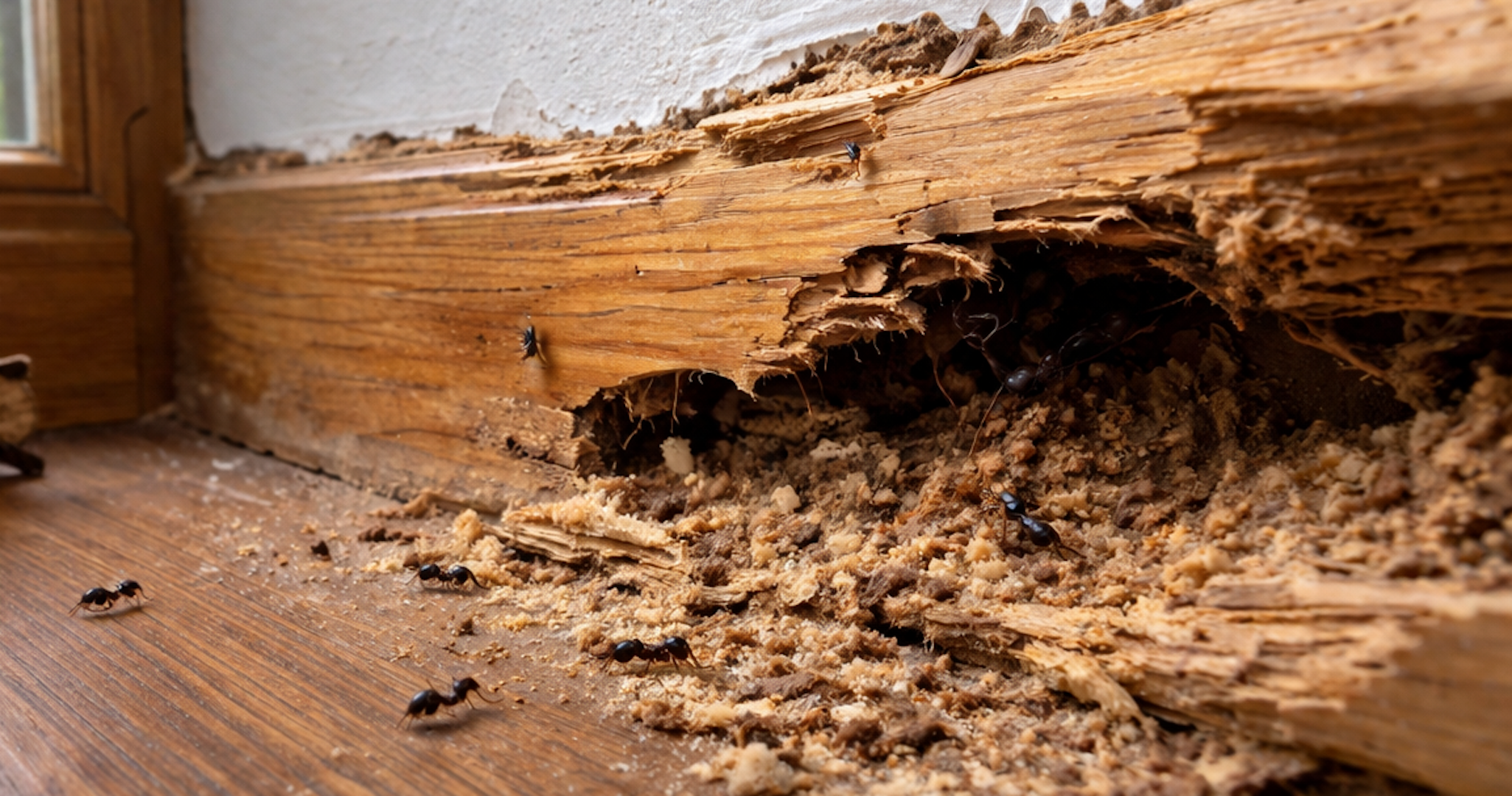
What Are the Signs of Carpenter Ants in a Poconos Home?
Most Poconos homeowners notice carpenter ants in one of three ways. Each sign points to a nest that is either inside the home or very close to it.
Large black ants indoors: Carpenter ants are bigger than typical kitchen ants. If you see ants that look too large to be pavement or odorous house ants (especially in kitchens, bathrooms, or near windows), treat that as a warning sign.
Frass (wood shavings): Small piles of coarse, stringy wood particles mixed with dead insect parts often sift from cracks in siding, behind moldings, in basements, and in attics. Because carpenter ants do not eat wood, they push excavated material out of the nest.
Winged swarmers indoors: If you see winged ants near windows or light fixtures in spring or early summer, a mature colony is likely nearby. Swarmers are reproductive ants leaving an established nest to start new ones.
Rustling sounds in walls: A faint crinkling or rustling behind drywall or ceilings can sometimes be heard with a stethoscope or an inverted drinking glass. This is often a satellite colony active inside the structure.
What Do Carpenter Ants Look Like?
Carpenter ants are some of the largest ants in Pennsylvania homes. Knowing their size, color, and shape helps you tell them apart from the smaller ants that also show up indoors.
Size, Color, and Key Features
- Size: Workers range from about a quarter inch to half an inch long. Winged reproductive ants are often even bigger.
- Color: Most Poconos carpenter ants are solid black. Some species have reddish or orangish tones on the thorax or legs.
- Body shape: Three distinct segments with a narrow, pinched waist.
- Antennae: Bent or elbowed, not straight.
- Wings (on swarmers): Two pairs. The front wings are noticeably longer than the hind wings.
- Jaws: Strong mandibles used to chew through wood (not to eat it).
The most common species in our region is the black carpenter ant, Camponotus pennsylvanicus. For a closer look at identification details, see Penn State Extension on carpenter ants.
Carpenter Ants vs Regular House Ants
Pavement ants and odorous house ants are the two most common nuisance ants found inside Poconos homes. Both are much smaller than carpenter ants.
- Pavement ants: About 1/8 inch long, dark brown to black. They usually trail in from cracks in concrete or along baseboards.
- Odorous house ants: About 1/8 inch long, dark brown. They give off a strong odor when crushed.
- Carpenter ants: Much larger (up to half an inch), with strong jaws and a preference for damp wood.
If the ants you see are noticeably bigger than the ones you usually find in the kitchen, you are likely dealing with carpenter ants.
Where Do Carpenter Ants Nest in Poconos Homes?
Carpenter ants need moisture. They prefer wood that has been softened by leaks, condensation, or long-term humidity. That preference shapes where nests show up in a home.
Common Indoor Nesting Spots
- Window and door frames, especially where caulking has failed
- Wall voids behind kitchens and bathrooms
- Attic rafters and roof decking near ice dam areas
- Basement sill plates and band joists
- Around chimneys and skylights where flashing leaks
- Under dishwashers and refrigerators with slow drips
- Foam insulation board, which is soft enough for satellite nests
Colonies often have a parent nest outdoors (in a stump, log, or standing dead tree) and one or more satellite nests inside the home.
Satellite nests hold workers, older larvae, and pupae, but not the queen. Homeowners usually see activity from satellite colonies long before they find the parent nest.
For more background on colony structure, see university research on carpenter ant colonies.
Why Poconos Homes Are Especially at Risk
The Poconos have three conditions that carpenter ants love: heavy forest cover, high seasonal humidity, and a lot of wood-framed vacation and seasonal homes.
- Wooded lots: Most properties here sit within a few feet of trees, stumps, and firewood piles that serve as parent nest sites.
- Moisture cycles: Heavy snow, ice dams, spring thaw, and summer humidity create repeated opportunities for wood to stay damp.
- Seasonal homes: Vacation properties often sit empty for weeks. Small leaks go unnoticed, and nests have time to grow before anyone sees them.
- Log cabins and wood siding: Common Pocono building styles give carpenter ants direct access to nestable wood.
What Is Carpenter Ant Frass and Why Does It Matter?
Frass is the mix of wood shavings, dead insect parts, and debris that carpenter ants push out of their galleries. It is the most reliable early sign of an indoor nest.
Why it matters: Frass means an active colony is excavating wood inside your home right now. It is not old damage. It is ongoing damage.
How to spot it: Look for small piles on window sills, in basement corners, near baseboards, under porches, and below attic vents. The piles often contain bits of insulation and bug parts, not just wood.
How to confirm it is carpenter ant frass: Carpenter ant galleries are smooth and clean, with no soil or mud. Frass from their tunnels has a stringy, coarse look. Termite damage, by contrast, includes soil and fecal pellets packed into the galleries.
Carpenter Ants vs Termites: How to Tell the Difference
This is the single most important distinction for a Pocono homeowner. Both pests damage wood, but the treatment, cost, and urgency are very different. Correct identification protects your budget and your home.
| Feature | Carpenter Ants | Termites |
|---|---|---|
| Appearance | Narrow, pinched waist; elbowed antennae; hard black or dark body | Broad waist with no pinch; straight, beaded antennae; soft pale or cream body |
| Wings (swarmers) | Two pairs, front pair longer than hind pair | Two pairs of equal length, longer than the body |
| Behavior with wood | Excavate wood to nest; do not eat it | Eat wood for its cellulose |
| Damage pattern | Smooth, clean galleries; frass pushed out through kick-out holes | Galleries packed with soil and fecal pellets; mud tubes on foundations |
| Wood appearance | Clean tunnels in damp or softened wood | Layered, blistered, or hollowed wood that looks like water damage |
| Where they are seen | Often visible on floors, counters, and near windows | Rarely seen outside the colony except when swarming |
If you see mud tubes along the foundation or crawl space, that points to termites, not carpenter ants. If you see big black ants and loose wood shavings, it points to carpenter ants.
Why Mount Pocono, Stroudsburg, and Tannersville See Frequent Carpenter Ant Activity
Carpenter ant calls spike in Mount Pocono, Stroudsburg, East Stroudsburg, and Tannersville every year. The reason comes down to landscape and housing stock.
Mount Pocono: Higher elevation, heavy tree cover, and many seasonal cabins give colonies steady access to moisture and wood.
Stroudsburg and East Stroudsburg: Older neighborhoods and homes near McMichael and Brodhead Creek deal with consistent humidity and aging wood trim.
Tannersville: Dense woods along Camelback and surrounding resort areas keep parent colonies close to homes, so satellite nests form fast inside the structures.
If you need help in any of these towns, our local carpenter ant treatment team handles calls year-round.
How Much Damage Can Carpenter Ants Cause?
Carpenter ants cause damage more slowly than termites, but the damage adds up. A colony left alone for several years can weaken beams, studs, window frames, and roof decking.
The damage pattern is predictable. Ants start in a spot of softened or water-damaged wood, then expand into neighboring dry wood as the colony grows. Satellite nests extend the problem to new parts of the home.
Typical repair scope: replacing a window frame and surrounding trim, cutting out a damaged section of sill plate, or rebuilding a corner of a porch. Structural repairs on older cabins can run into thousands of dollars, especially when hidden moisture damage is also found.
The faster you confirm and treat the nest, the smaller the repair. Homeowners who catch carpenter ants at the first signs of frass usually avoid major reconstruction.
For background on wood degradation from wood-destroying insects, see research on wood-destroying insects.
What to Do If You Think You Have Carpenter Ants
Take these four steps in order. They protect the home while you get a professional inspection scheduled.
- Do not spray the ants you see. Store-bought sprays scatter the colony and push satellite nests deeper into the structure. This makes the problem harder to find and treat.
- Photograph the evidence. Take clear photos of the ants, any frass piles, and the spots where you see activity. This helps a technician identify the species and plan an inspection.
- Fix obvious moisture issues. Clear gutters, repair leaking pipes, and pull firewood and mulch back from the foundation. Carpenter ants need damp wood; removing the moisture makes your home less welcoming.
- Schedule a professional inspection. A technician can locate the parent nest, map satellite colonies, and treat the whole structure instead of just the ants you see. Our Home Protection Plan includes ongoing carpenter ant coverage, which is often the most cost-effective path for Pocono homes surrounded by woods.
Carpenter Ant FAQs
How do I know if the ants in my house are carpenter ants?
Look at size and color. Carpenter ants are noticeably larger than typical kitchen ants (a quarter to half an inch) and are usually solid black. If you also see loose wood shavings or winged swarmers in spring, you are almost certainly dealing with carpenter ants.
Are carpenter ants as dangerous as termites?
Carpenter ants cause damage more slowly than termites, but both can weaken structural wood over time. In the Poconos, untreated carpenter ant colonies in seasonal homes often cause damage that rivals termite damage simply because the infestation is missed for years.
Do I really need to call a professional?
Yes. The ants you see are foragers, not the nest. Locating the parent colony and any satellite nests requires inspection experience and often specialized tools. DIY treatments rarely reach the queen, so the colony rebuilds.
When are carpenter ants most active in the Poconos?
Carpenter ants are most visible from late spring through early fall, with swarmers emerging on warm days in spring and early summer. Activity slows in winter, though nests inside heated parts of a home can stay active year-round.
Can I tell the size of the colony from how many ants I see?
Not reliably. A mature colony may have thousands of workers but only send a handful indoors to forage. Seeing even a small number of large black ants on a regular basis is enough reason to schedule an inspection.
Have more questions? Visit our carpenter ant FAQ for a full list of common questions Pocono homeowners ask.