
Mouse droppings are small, about the size of a grain of rice, with pointed ends, and they are scattered everywhere the mouse travels. Rat droppings are two to three times larger, about the size of a raisin or a bean, with blunt ends, and they are left in groups. Bat guano looks like mouse droppings at a glance but is found in piles below a roost and crumbles into a shiny powder of insect parts when pressed. Size, ends, and location answer the question in under a minute.
Getting the answer right matters because the treatment changes with the species. Mice need small-gap exclusion and small stations. Rats need heavier sealing, larger stations, and more follow-up. Bats cannot be trapped or poisoned at all in Pennsylvania and are removed by exclusion. Professional rodent control starts with identification for exactly this reason.
Here is the full comparison, what the location of the droppings tells you, how to tell fresh from old, and the cleanup rules that protect your family.
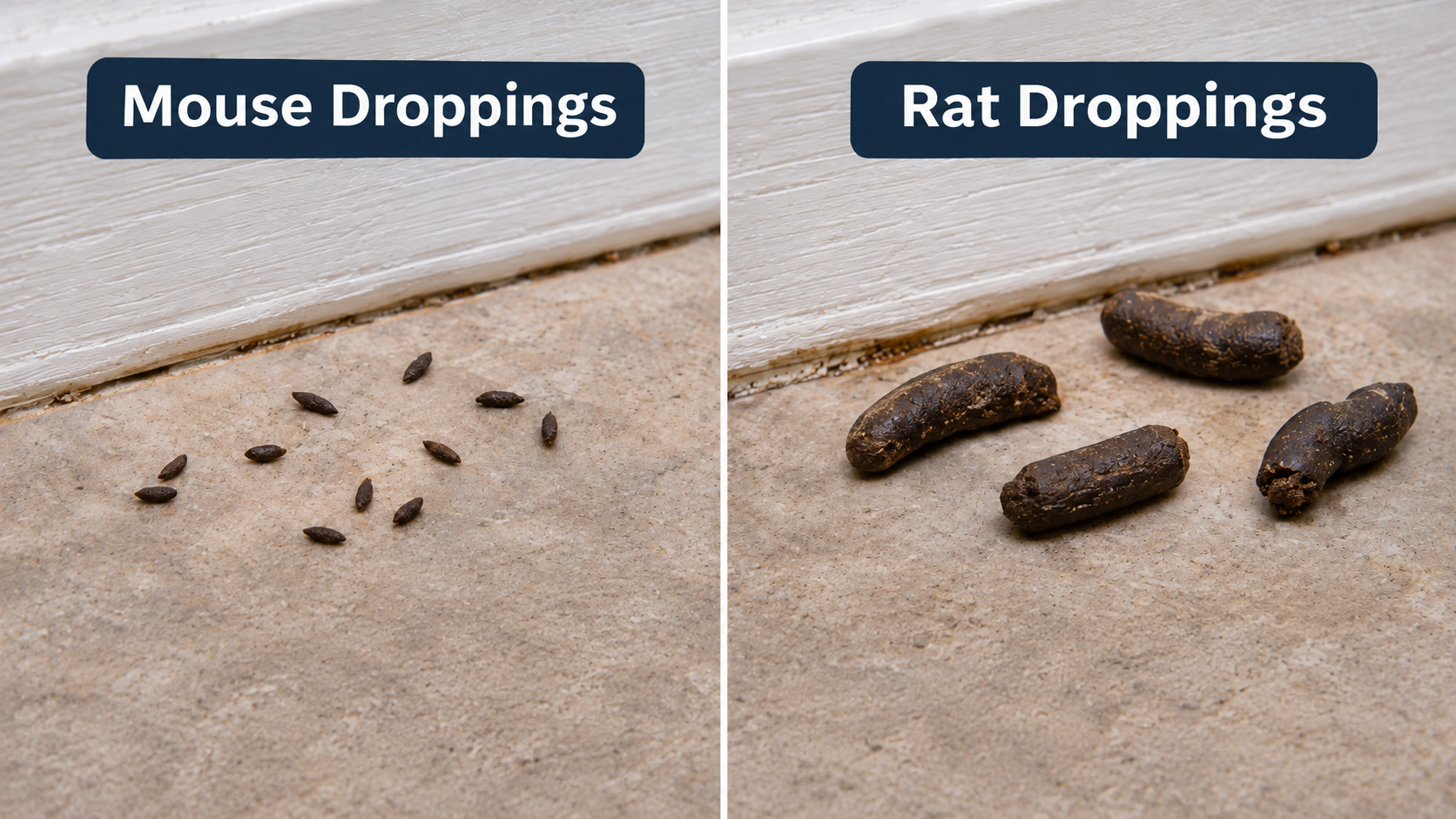
Mouse vs. Rat vs. Bat Droppings: Side-by-Side
| Feature | House Mouse | Norway Rat | Bat (Guano) |
|---|---|---|---|
| Length | 1/8 to 1/4 inch | 1/2 to 3/4 inch | About 1/4 inch |
| Shape | Thin, rod-shaped, pointed at both ends | Thick, capsule-shaped, blunt ends | Rod-shaped, slightly segmented |
| Color | Dark brown to black | Dark brown to black | Dark brown to black |
| Texture when pressed | Hard, holds shape | Hard, holds shape | Crumbles into shiny, powdery insect fragments |
| Quantity | 50 to 75 per mouse per day, scattered | 30 to 50 per rat per day, grouped | Piles that build up below the roost |
| Where found | Along walls, in drawers, pantries, under sinks, on counters | Along runways, near burrows, in basements, under decks, around dumpsters | Attics, below gable vents, on sills under entry gaps, outside walls |
| Companion signs | Gnaw marks on food packaging, shredded nesting | Greasy rub marks on walls, burrows, large gnaw marks | Staining at entry gaps, chirping at dusk, ammonia odor |
| Typical NEPA setting | Nearly every home, especially pre-1940 housing | Downtown and commercial corridors, near streams | Wooded lots, older attics, lake cottages |
Technician note: When a homeowner sends us a photo, the first thing we check is the ends. Pointed means mouse. Blunt means rat. If the droppings are in a pile under one spot in the attic and fall apart to a glitter when touched, it is bats, and the job changes completely.
What Does the Location of the Droppings Tell You?
Location often confirms the species before you measure anything.
Kitchen counters, pantry shelves, drawers, and under the sink point to mice. They explore constantly, climb well, and leave droppings everywhere they go, including on top of food packaging.
Basement floors, crawl spaces, along foundation walls, under decks, and near dumpsters or compost point to rats. Norway rats stay low, travel the same runways nightly, and leave greasy smudge marks along the walls they follow.
Attics, directly below a gable vent, on a windowsill under a roofline gap, or on the ground outside one spot on the wall point to bats. Guano accumulates where bats enter and roost, not along runways.
Garages and vehicles can be any of the three, but mice are the usual culprit, nesting in engine bays and cabin filters as nights cool.
In NEPA’s older housing stock, mice are the default assumption. Our guides to DIY versus professional mouse control and what rodent control costs cover what happens after the ID. If you suspect bats, our guide to bats in your PA home before winter explains the exclusion timeline.
Are the Droppings Fresh or Old?
Fresh droppings mean an active infestation. Old droppings may mean a past one, but assume active until proven otherwise.
Fresh. Dark, moist-looking, soft if pressed with a gloved finger or a tool, and often found with a strong ammonia odor from urine. Fresh mouse droppings in a cleaned area within 24 hours confirm current activity.
Old. Gray, dusty, hard and brittle, and may crumble. Old droppings alone do not prove the problem is over, because rodents can be active elsewhere in the house.
The reliable test is simple. Clean an area thoroughly following the cleanup rules below, then check it the next morning. New droppings mean the population is active.
How Do You Clean Up Rodent Droppings Safely?
Never sweep or vacuum rodent droppings dry. That is the one rule that matters most, because stirring up dried droppings and urine can release particles into the air. Deer mice, which are common on wooded lots across NEPA, are the primary carriers of hantavirus in Pennsylvania. Cases are rare, but the CDC’s rodent cleanup guidance exists for that reason, and it is the standard our technicians follow.
- Ventilate. Open doors and windows for 30 minutes before cleaning and leave the area during that time. For a vehicle, open the hood, doors, and trunk for 20 minutes.
- Glove up. Wear rubber or plastic gloves.
- Wet everything down. Spray droppings, nests, and dead rodents with an EPA-registered disinfectant or a fresh bleach solution of 1.5 cups of bleach per gallon of water until thoroughly wet, then wait five minutes.
- Wipe, do not sweep. Pick up droppings with paper towels and discard in a covered trash can. Double-bag dead rodents and nests.
- Disinfect the area and wash up. Wipe surfaces with disinfectant, wash gloved hands with soap and water before removing gloves, then wash bare hands.
Heavy infestations in attics or crawl spaces, and bat guano deposits of any size, call for a respirator and professional handling. The CDC’s hantavirus prevention guidance covers the extra precautions, and our guide to deer mice versus house mice explains which species you are likely dealing with.
Why Does the Species Change the Treatment?
Because each animal enters, nests, and behaves differently, and a treatment built for the wrong one fails.
Mice need every gap larger than a nickel sealed, per the CDC’s exclusion guidance, small tamper-resistant stations along walls, and follow-up within two weeks. They are curious and approach new traps quickly.
Rats need gaps down to a quarter sealed with heavier materials, larger stations, and longer follow-up, because they are wary of new objects for days. Rat work often extends outdoors to burrows and food sources.
Bats are protected in Pennsylvania and cannot be trapped, poisoned, or relocated. The Pennsylvania Game Commission’s bat control practices call for one-way-door exclusion timed outside the May 15 to August 1 maternity season and before winter hibernation. October is the last reliable window. Our bat exclusion service follows that guidance.
Misidentify rats as mice and the stations are too small and the sealing too light. Misidentify bats as mice and you have poisoned a protected species while the colony stays in the attic. Identification is the whole first visit.
When Should You Call a Pro?
Call a professional when droppings appear on more than one floor, when fresh droppings return within a day of cleaning, when you find them in food storage, when the droppings are rat-sized at all, or when anything suggests bats. Each of those means an established population or a protected species, and both call for a licensed technician.
The Pest Rangers identifies the species on a free inspection, seals entry points, removes the population, and documents the work under a written guarantee with free return visits. Every technician is licensed by the Pennsylvania Department of Agriculture. If you are in the Hazleton area, our guide to hiring a mouse exterminator covers what to ask, and our guide to 7 myths about mice and rats explains why waiting makes it worse.
FAQs
How can you tell mouse droppings from rat droppings?
Size and ends. Mouse droppings are 1/8 to 1/4 inch with pointed ends and are scattered widely. Rat droppings are 1/2 to 3/4 inch with blunt ends and are left in groups along runways. Rats also leave greasy rub marks and larger gnaw marks.
What is the difference between mouse droppings and bat droppings?
They are similar in size, but bat guano is found in piles below a roost or entry gap and crumbles into a shiny powder of insect parts when pressed. Mouse droppings are hard, hold their shape, and are scattered along walls and in cabinets.
Is it safe to vacuum mouse droppings?
No. Vacuuming or sweeping dry droppings can release particles into the air, which is the hantavirus risk the CDC warns about. Ventilate, wet the droppings with disinfectant, wait five minutes, and wipe them up with paper towels while wearing gloves.
How many droppings does one mouse leave per day?
A single mouse can leave 50 to 75 droppings a day, which is why a modest infestation produces so many so fast. Finding droppings in several rooms usually means several mice, not one busy one.
Do old droppings mean the mice are gone?
Not necessarily. Old droppings are gray and brittle, but rodents may be active elsewhere in the house. Clean the area completely, check it the next morning, and treat any new droppings as proof of an active population.